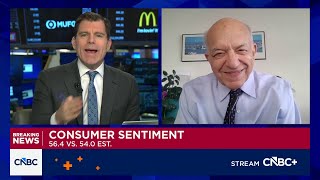
Watch CNBC’s full interview with Wharton’s Jeremy Siegel

Watch on YouTube ↗  |  January 23, 2026 at 16:52  |  7:07  |  CNBC
Speakers
Jeremy Siegel — Professor of Finance, Wharton School

Summary

Jeremy Siegel, Wharton professor emeritus and WisdomTree chief economist, tells CNBC that the broadening of the market has legs and that a stronger economy favors value and small-cap stocks. He expects two more Fed rate cuts, which should help small caps, and sees AI adoption by low-PE companies as a margin driver. He also describes a jobless boom with weak payrolls but strong GDP and expects the 10-year Treasury yield to remain sticky around 4-4.5%, not becoming worrisome until 5%.

  • Siegel says market broadening is durable and favors value and small-cap stocks.
  • He expects two more Fed rate cuts, which disproportionately help small caps.
  • He calls it the year of the AI user, with adoption potentially cutting costs and lifting margins.
  • He describes a jobless boom of weak payrolls and strong GDP.
  • He expects the 10-year Treasury yield to stay near 4-4.5% and not worry until 5%.
  • He questions whether the Mag-7 will remain 2026 market leaders.
Ideas
Jeremy Siegel Professor of Finance, Wharton School 1:14
Stronger economy and AI favor value stocks.
Siegel argues the market broadening has legs and that a stronger economy favors value stocks. With many value stocks trading around 15x earnings, modest nominal GDP-like growth can still deliver strong returns, and the coming AI adoption wave could cut costs and expand margins, giving low-PE companies significant multiple leverage.
Jeremy Siegel Professor of Finance, Wharton School 1:14
Rate cuts favor small-cap stocks.
Siegel expects two more rate cuts and says lower short-term rates disproportionately help small caps versus large caps. Combined with a stronger economy and tax-cut-supported consumer spending, this should underpin small-cap outperformance.
Jeremy Siegel Professor of Finance, Wharton School 6:11
10-year yield likely stays 4-4.5%.
Siegel does not expect much relief on the long end of the curve. He notes Fed funds historically average about 110 basis points below the 10-year Treasury yield, so with the 10-year at roughly 4.2%, Fed funds should fall into the low 3s while the 10-year stays around 4-4.5%. He would not become worried unless the 10-year approaches 5%.
Up Next

This CNBC video, published January 23, 2026, features Jeremy Siegel discussing Value stocks, IWM, 10-Year Treasury Yield. 3 trade ideas extracted by AI with direction and confidence scoring.

Speakers: Jeremy Siegel  · Tickers: Value stocks, IWM, 10-Year Treasury Yield