Goldman's Solomon Says Markets Trying to Figure Out Iran Endgame
Speakers
David Solomon
— Chairman and CEO, Goldman Sachs
Summary
- Markets are currently reacting benignly to the Middle East conflict involving Iran, despite the potential for escalation.
- Goldman's strategy team (Peter Oppenheimer) is advising clients to "buy the dip," suggesting the geopolitical risk is not yet a structural threat to the broader economy.
- The primary risk transmission mechanism identified is "energy supply chains," though markets are currently pricing in a scenario where supply remains uninterrupted.
- Long-term allocators are advised to hold steady, while short-term traders are monitoring risk premia for signs that the conflict is affecting economic growth.
Ideas
The interviewer notes that Goldman's strategy team, led by Peter Oppenheimer, is explicitly saying to "buy the dip." Solomon adds that for wealth clients, "there's nobody that's saying you should change your fundamental portfolio allocation." Despite the geopolitical noise, the "Smart Money" (Goldman) views the current conflict as a volatility event rather than a fundamental cycle-ender. If the recommendation is to not alter long-term allocation and to buy weakness, the trade is to remain long broad US equities. LONG broad indices as the baseline view is that the conflict will be contained. A sudden escalation that drags the US directly into kinetic warfare, causing a market-wide repricing.
Solomon mentions there is "a lot of uncertainty around the direction of the conflict... what the off-ramps are" and that markets are trying to figure out the "Iran endgame." The explicit mention of "Iran" and the lack of clear "off-ramps" implies a prolonged period of heightened tension and deterrence. In a world where the "endgame" is unclear, governments are forced to replenish munitions and upgrade defense capabilities. This creates a sustained tailwind for prime defense contractors regardless of whether the broader market "buys the dip." LONG US Defense Primes as a structural beneficiary of the "uncertainty" Solomon describes. A sudden, comprehensive peace treaty or de-escalation would compress valuation multiples in the defense sector.
Solomon states that market participants are watching to see if the conflict translates to "things that affect economic growth and activity particularly energy supply chains." Energy is identified as the single "choke point" where geopolitical risk becomes economic reality. While Solomon notes markets are currently "encouraged" (meaning risk premium is low), he emphasizes that the outcome is "uncertain" and depends on the "Iran endgame." If the benign scenario fails, energy is the asset class that will reprice most violently to the upside. WATCH for a breakout. If news flow worsens, Long Oil (USO) or Energy Majors (XLE) acts as the necessary hedge against the "difficult scenarios" Solomon alludes to. If the conflict de-escalates or remains a proxy war without supply disruption, the "war premium" in oil will evaporate, causing prices to drop.
Up Next
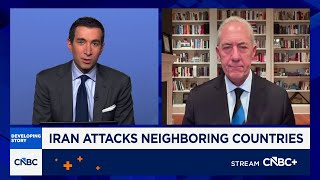
This Bloomberg Markets video, published March 05, 2026, features David Solomon discussing SPY, QQQ, RTX, GD, LMT, XLE, USO. 3 trade ideas extracted by AI with direction and confidence scoring.
Speakers: David Solomon · Tickers: SPY, QQQ, RTX, GD, LMT, XLE, USO