Ideas
Underweight U.S. equities amid tariff, stagflation risks.
If the U.S. and China stay at 145%/125% tariffs, the recent equity rally will reverse and equities will tank again. Tariffs and policy uncertainty raise input costs and force business-model changes; in the stagflation he expects, inflation remains high while growth slows, so equity prices fall. Valuations may need to compress from about 20x to 12x earnings, causing a large decline before markets can recover. He also recommends underweighting the U.S. in a multi-month allocation.
Avoid long-duration bonds and munis.
Trump's pressure on the Fed and Mar-a-Lago Accord debt-restructuring talk have introduced sovereign risk into U.S. paper, threatening the Treasury's risk-free status and raising the chance of a downgrade to AA/A+ from AAA. A downgrade would require higher yields, and in stagflation bond yields rise while equity prices fall, so long-duration bonds and long-dated municipals are risky; he advises low duration exposure.
60/40 portfolio fails in stagflation.
In a stagflationary environment, bond yields go up and equity prices come down, so investors lose in both bonds and equities; the traditional 60/40 portfolio does not work, as it did not in 2022. He recommends allocating part of the portfolio outside 60/40.
Favor short-dated T-bills as safe haven.
In a stagflationary environment where both bonds and equities can lose, he would hide part of the portfolio in short-dated, highly rated instruments such as 3-month and 6-month Treasury bills. They have no duration risk and still offer a decent yield; he ranks them as the second-best safe haven after gold, assuming the Mar-a-Lago Accord debt restructuring is not implemented. Later he recommends overweighting short-dated high-grade fixed income and being low-weighted in duration risk.
Gold is top safe-haven asset.
Gold is his top safe haven and hiding place. If the world deteriorates or investors flee all paper currencies, gold is the single biggest beneficiary; it rose $125 in one day and can resume its rise. He recommends holding part of the portfolio in gold, though he notes it loses appeal if it spikes substantially or if Treasury yields rise to 5%+ because gold produces no income.
Use alternatives outside traditional 60/40 portfolio.
In stagflation, the 60/40 portfolio fails, so he recommends putting a chunk of the portfolio in well-chosen alternative investments outside traditional stock/bond calculations. These can protect assets over multi-year horizons and avoid daily mark-to-market pressure.
Residential real estate protects over five-seven years.
He favors well-managed residential real estate as an alternative investment: give a good manager money to hold for five to seven years, ignore daily NAV moves, and wait for the mortgage market to recover. This helps protect the bulk of assets in a stagflationary environment.
Distressed U.S. commercial real estate attractive.
Commercial real estate sentiment is improving and 2024 was the worst. Transactions have picked up because holders accept prices will not return to 2019 levels, and banks are ending extend-and-pretend and selling assets. Office buildings have traded at 40-50% of 2019 prices; well-located buildings at such discounts offer an attractive opportunity and can recover in price.
Commodities benefit from coming inflation.
Because he expects inflation to pick up in a stagflationary environment, he says investors should look at commodities; some commodities will benefit when inflation rises, making the asset class a place to go.
Buy Brent crude near fifty dollars.
Oil has fallen substantially and will at some point soon become a buy; he suggests around $50 for Brent crude, or $45-$50, as the level. Commodities should benefit when inflation picks up under stagflation.
Reduce U.S. dollar exposure on policy damage.
The dollar has weakened not because other economies are booming but because Trump policies actively undermined it—trying to make the dollar cheaper and discussing debt restructuring—causing a flight from the currency. A DXY drop from 106/107 to below 100 reduces Americans' global purchasing power; in a currency portfolio, he would reduce the dollar weight relative to three to six months ago, while still keeping a significant USD allocation because it remains the world's biggest market.
Overweight non-U.S. equities, especially Japan and Europe.
For the next two to three months, he would underweight the United States and overweight the rest of the world because capital is leaving the U.S. amid dollar weakness, sovereign-risk concerns, and policy uncertainty. The overweight is specifically in Japan and Europe; emerging markets are only market weight.
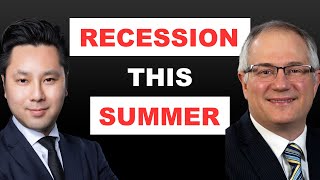
This The David Lin Report video, published April 27, 2025,
features Komal Sri-Kumar
discussing SPY, TLT, MLN, 60/40 Portfolio, BIL, GLD, Alternative investments, REZ, U.S. commercial real estate, Distressed U.S. office buildings, DBC, BNO, UUP, Non-U.S. equities, EWJ, VGK.
12 trade ideas extracted by AI with direction and confidence scoring.
Speakers:
Komal Sri-Kumar
· Tickers:
SPY,
TLT,
MLN,
60/40 Portfolio,
BIL,
GLD,
Alternative investments,
REZ,
U.S. commercial real estate,
Distressed U.S. office buildings,
DBC,
BNO,
UUP,
Non-U.S. equities,
EWJ,
VGK