Tesla CEO Elon Musk speaks at the World Economic Forum in Davos, Switzerland — 1/22/2026
Summary
Elon Musk spoke with BlackRock CEO Laurence Fink at the World Economic Forum in Davos, covering AI, robotics, Tesla, SpaceX, energy, and space. Musk predicted rapid AI advancement, widespread humanoid robots, and a solved self-driving problem, while outlining Tesla Optimus and robotaxi timelines. He argued electrical power is the key AI bottleneck and promoted solar, including space-based solar AI data centers, plus SpaceX's Starship reusability as a major cost breakthrough. The conversation ended with Musk's optimistic outlook on technology and civilization.
- Elon Musk discussed AI, robotics, energy, space, and Tesla's operations with Laurence Fink at Davos.
- Musk expects AI to surpass human intelligence by the end of this year or next and all humanity by 2030-2031.
- He sees humanoid robots as a path to abundance, with Tesla Optimus factory tasks now and public sales targeted by the end of next year.
- Musk says self-driving is essentially solved, with Tesla robotaxi expansion planned and regulatory approvals sought in Europe and China.
- He identifies electrical power as the main AI deployment bottleneck and highlights solar as the dominant energy source.
- SpaceX aims to prove Starship full reusability this year, potentially cutting space access costs by 100x.
- Musk advocates solar-powered AI data centers in space, arguing space will be the lowest-cost AI location within a few years.
- The conversation ended with Musk encouraging optimism about technology and the future.
Ideas
Up Next

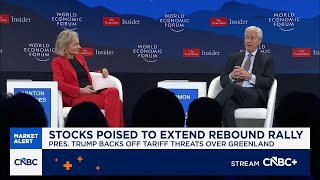

This CNBC video, published January 22, 2026, features Elon Musk discussing AI-SECTOR, Humanoid robotics, XLU, China solar, SOLAR, Space-based AI data centers, TSLA, Autonomous driving, SPCX. 9 trade ideas extracted by AI with direction and confidence scoring.
Speakers: Elon Musk · Tickers: AI-SECTOR, Humanoid robotics, XLU, China solar, SOLAR, Space-based AI data centers, TSLA, Autonomous driving, SPCX