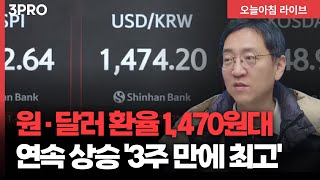
What Are the Three Most Important Variables in the Stock Market in January and February? | 3PRO TV Economist Dr. Kim Han-jin

1~2월 증시 속 가장 중요한 변수 3가지는? | 삼프로TV 이코노미스트 김한진 박사 [인뎁스60]
Watch on YouTube ↗  |  January 14, 2026 at 00:18  |  25:03  |  3PRO TV (삼프로TV)
Speakers
Kim Han-jin — Economist

Summary

Kim Han-jin argues that Korea's semiconductor-driven market leadership can continue, supported by AI/data-center capex, upward earnings revisions, and export-sector strength, though he expects a first-half peak and only a mild correction. He favors Korean export leaders such as semiconductors, autos, bio, and power/SMR, while viewing the domestic economy as weak. He also expects the Bank of Korea to hold rates and sees USD/KRW moving back toward 1400 as the dollar weakens.

  • Kim Han-jin says the Korean market is in a semiconductor supercycle, with Samsung Electronics and SK hynix earnings still being revised upward.
  • He expects a first-half 2026 peak in the semiconductor cycle but not a collapse, as AI/data-center capex may continue to 2028.
  • He sees January strength and January-leading sectors as historically correlated with full-year return leadership.
  • He favors Korean export sectors: semiconductors, autos, bio, defense, and energy/power, with SMRs highlighted for AI power demand.
  • He expects the Bank of Korea to hold rates due to household debt and FX constraints.
  • He views the domestic Korean economy as weak but export companies as strong.
  • He expects USD/KRW to move toward 1400 rather than 1500-1600 in the first half, and DXY to weaken.
  • He says stable FX could encourage more foreign inflows into Korean equities.
Ideas
Kim Han-jin Economist 2:41
Korean chip supercycle positive, H1 peak risk
Kim argues Korean semiconductors are in the strongest phase of a data-center-driven memory supercycle. Samsung Electronics and SK hynix earnings are being revised upward, DRAM prices are running above prior expectations, and valuations remain undemanding on current earnings. He sees scope for more upside if combined operating profit reaches the 250-300 trillion won range, but expects a first-half peak-out and only a mild correction as long as AI/data-center capex continues toward 2028.
Kim Han-jin Economist 3:58
KOSPI supported by export earnings growth
Kim sees the KOSPI as supported by a roughly 30% expected increase in EPS, with semiconductors contributing more than half and export sectors providing the rest. He also cites the historical pattern that January strength has about a 70% correlation with full-year returns and that January-leading sectors tend to stay annual leaders, while stable FX could encourage foreign inflows. He still expects a possible first-half peak and later correction.
Kim Han-jin Economist 14:01
High FX favors Korean strategic exporters
Kim argues that even if the won does not weaken much, a high FX environment favors Korea's strategic export industries. These exporters are the main source of KOSPI earnings growth, and foreign investors may selectively buy them despite the weak domestic economy. He names autos, bio, chips, defense, and energy/power as the remaining sector drivers after semiconductors.
Kim Han-jin Economist 14:32
Korean bio now strategic export sector
Kim lists bio as a remaining KOSPI earnings contributor and argues it has become a strategic export industry for Korea, with meaningful export growth. This gives the sector an independent export-driven rationale within his 2026 leadership framework.
Kim Han-jin Economist 14:47
AI power demand benefits SMR exports
Kim expects the AI cycle to move from generative AI to agent AI and robotics, which should sharply increase electricity consumption. He sees Korea exporting more power-related equipment, explicitly highlighting SMRs and related stocks as beneficiaries of this third-stage AI buildout.
Kim Han-jin Economist 16:00
Korean autos attractive, robotics optionality
Kim includes autos as one of the non-semiconductor KOSPI earnings drivers. He adds that autos remain attractive and are increasingly being re-rated through robotics exposure as automakers move into robot-related businesses.
Kim Han-jin Economist 22:24
Dollar weakness, USD/KRW toward 1400
Kim does not expect USD/KRW to keep rising toward 1500-1600. He thinks the won can strengthen back toward the 1400 area in the first half because yen weakness should stabilize and the US is likely to be the most easing major economy in 2026, especially with political pressure before the November midterms. He explicitly says global DXY may weaken, which would make foreign inflows into Korea easier.
Up Next

This 3PRO TV (삼프로TV) video, published January 14, 2026, features Kim Han-jin discussing 005930.KS, 000660.KS, EWY, Korean Export Sectors, Korean biotech/pharma, SMR, XLE, Korean autos, USD/KRW, DXY. 7 trade ideas extracted by AI with direction and confidence scoring.

Speakers: Kim Han-jin  · Tickers: 005930.KS, 000660.KS, EWY, Korean Export Sectors, Korean biotech/pharma, SMR, XLE, Korean autos, USD/KRW, DXY