Ideas
Buy Korean stocks on the dip
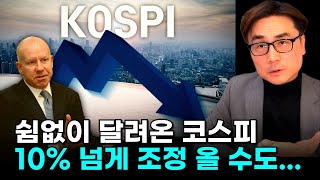
The Kevin Warsh Fed-chair nomination shock and the sharp KOSPI drop are not a change in the market's major trend; after a steep rally, a correction is healthy. He expects the market to rest until around March and then resume rising, so the selloff is a good buying opportunity; if February rose as much as January, that would be more worrying.
US banks benefit from deregulation
Even if Warsh cuts rates more slowly, the policy mix may shift toward Treasury issuance plus bank deregulation, allowing private banks to absorb government bonds and easing private financial conditions. US bank stocks were already strong while IT and gold/silver weakened, supporting the view that financials benefit from this policy mix.
Liquidity favors AI, defense, space
With fiscal and bank-deregulation easing likely to create liquidity even if rate cuts are slower, the money created should be directed into AI, defense, and space investment. This keeps those themes supported and is a broad allocation view alongside his more specific space/defense stock ideas.
Won weakness risk persists
If US rate cuts and liquidity are delayed, the dollar may remain relatively firm and continue pressuring the won; the Bank of Korea is stuck because hiking is too difficult and cutting is also hard with a weak won. Until the dollar index falls, Korea must endure FX instability, raising the risk of foreign outflows from Korean assets.
SanDisk valuation is attractive but volatile
SanDisk's P/E based on guidance is below 10x, so he previously said it was buyable in US stocks; however, the stock is extremely volatile and near-term moves are unpredictable, so the valuation edge does not guarantee an immediate rally.
Morgan Stanley targets look inconsistent
Morgan Stanley sharply raised Samsung and SK hynix earnings estimates but only lifted target prices to 210,000 won and 1.1 million won, which is internally inconsistent; either the earnings forecasts are too high or the targets are too low. Because the reported earnings power would imply much higher targets, actual prices may not reach those targets, so investors need to monitor whether 2027 estimates are revised or cut.
KOSDAQ policy support drives money rotation
The government is actively supporting KOSDAQ through delisting/relisting reforms and institutional buying; as KOSPI money rotates after the correction, KOSDAQ and index products such as KODEX KOSDAQ 150 Leverage can attract retail flows. He does not think KOSDAQ 3,000 is impossible and views the February/March correction as a chance to buy.
Samsung and SK hynix remain too cheap
Samsung Electronics and SK hynix remain too cheap: SK hynix is expected to show 60%+ operating margins and 50%+ net margins while trading around 6x P/E, so even a threefold price rise would not make it expensive. If Morgan Stanley's much higher 2027 earnings estimates are right, target prices should be far above current levels, making a sharp semiconductor correction a long-term buying opportunity.
KOSDAQ laggards can catch up
KOSDAQ's representative sectors—semiconductor equipment/materials, pharma/biotech, and secondary batteries—have lagged badly while the index rose. If money rotates from KOSPI and from profit-taking in better-performing sectors into KOSDAQ, these un-gone sectors should benefit, so investors who bought highs should not panic and can use the correction to enter.
KOSPI may range before rising
If the Warsh/Fed uncertainty is resolved well, the KOSPI could eventually reach 6,500, but there is no guarantee it will not first fall to 4,500, so investors should use staggered buying rather than going all-in. The direction is ultimately higher if uncertainty clears, but near-term volatility requires patience and split purchases.
Hanwha Aerospace orders support upside
Defense orders and upward target-price revisions support Hanwha Aerospace; reports have been raised repeatedly in January, and even during the macro selloff the prior target prices are not being lowered because order momentum remains. Holders should wait rather than sell into macro weakness.
Satrec can follow global peers
Satellite imagery is becoming a real business; analysts have sharply raised target prices from 70,000 to 160,000 won and from 100,000 to 200,000 won while the stock trades around 190,000 won. Compared with global peer Planet Labs, which trades at much higher PSR/PER multiples, Satrec could rise materially if liquidity remains favorable and it follows even half of the peer's multiple.
Watch SeAH Besteel earnings revisions
It is a steel company with space exposure; after being recommended around 40,000 won, it reached 72,000 won and broker reports now cluster around an 89,000 won target. If order momentum confirms and earnings forecasts are revised upward, it can rise further, but because the thesis depends on estimate revisions, investors should watch rather than chase.
This 3PRO TV (삼프로TV) video, published February 02, 2026,
features Lee Chang-dae, Kim Jang-yeol
discussing EWY, KBE, AI-SECTOR, ITA, ESA, USD/KRW, SNDK, 005930.KS, 000660.KS, KOSDAQ, 233740.KS, Korean semiconductor equipment/materials sector, XLV, KARS, 012450.KS, 099320.KQ, 001430.KS.
13 trade ideas extracted by AI with direction and confidence scoring.
Speakers:
Lee Chang-dae,
Kim Jang-yeol
· Tickers:
EWY,
KBE,
AI-SECTOR,
ITA,
ESA,
USD/KRW,
SNDK,
005930.KS,
000660.KS,
KOSDAQ,
233740.KS,
Korean semiconductor equipment/materials sector,
XLV,
KARS,
012450.KS,
099320.KQ,
001430.KS