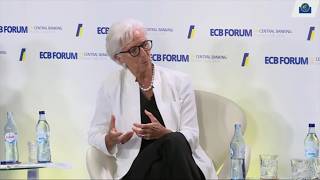
LIVE: CNBC's Sara Eisen moderates a policy panel at the ECB Forum on Central Banking 2026 — 7/1/26
Speakers
Kevin Warsh
— Federal Reserve Chairman
Tiff Macklem
— Governor of the Bank of Canada
Christine Lagarde
— President, European Central Bank
Summary
Central bank chiefs from the Fed, ECB, BoE and BoC discuss policy divergence, the end of forward guidance, AI's economic and financial stability implications, and balance sheet strategy, while reaffirming their commitment to price stability and independence.
- ECB hiked rates in response to the Middle East oil shock, while the Fed, BoE and BoC held steady, each citing different starting points and economic conditions.
- All four central bankers reject explicit forward guidance, preferring 'framework guidance' that explains their reaction function without pre-committing to rates.
- AI is seen as a transformative general-purpose technology; the US is experiencing an AI-driven capex boom, but the ultimate inflation/disinflation impact remains uncertain.
- Financial stability concerns are rising: equity valuations appear stretched, and highly leveraged hedge fund positions in sovereign debt and equities pose systemic tail risks.
- Fed Chair Warsh expresses optimism about US productivity and growth, hinting at a potential structural upshift, while emphasizing interest rate policy as the primary tool.
- Governor Bailey notes a softening UK economy and delayed energy pass-through, keeping rate cuts off the table for now.
- President Lagarde stresses that Europe must advance capital market union and venture capital to boost growth, and warns against rolling back post-crisis banking regulation.
- All panelists strongly defend central bank independence, with Warsh stating the Fed will follow the Supreme Court ruling and remain focused on its dual mandate.