Trump: US Requests Delay of Xi Summit Amid War | Balance of Power 03/16/2026
Speakers
Kailey
— Host
Skyler Woodhouse
— Reporter, Bloomberg News
Maggie Goodlander
— Member of Congress (Armed Services Committee)
Heather
— Former Deputy Assistant Secretary of State for European and Eurasian Affairs
Ed Ludlow
— Co-Host, Bloomberg Technology
Jennifer
— Chief Economics Analyst, Bloomberg Economics
Rick
— Republican Political Analyst
Jeannie
— Democrat Political Analyst
Summary
- The U.S.-Iran war has closed the Strait of Hormuz, keeping Brent crude oil above $100/barrel for three consecutive sessions, the longest streak since 2022, threatening a global recession.
- President Trump's request for allied help to reopen the strait is met with reluctance; China is unlikely to assist, and European allies are hesitant to join a U.S.-led coalition.
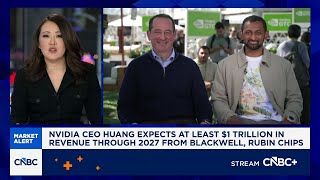
- NVIDIA's CEO projects at least $1 trillion in cumulative revenue from AI chips by 2027, signaling sustained, massive demand.
- Supply chain risks for chipmaking (e.g., helium from Qatar) exist but may be muted as high-value chips are shipped by air.
- Trump hints at "taking Cuba," suggesting further geopolitical volatility in the Western Hemisphere.
Ideas
"Brent crude closed above $100 per barrel for a third straight session... Investors remain on edge about supply disruptions in the Middle East." The closure of the Strait of Hormuz, a critical chokepoint for global oil shipments, is a direct result of the U.S.-Iran war. This physical supply disruption has driven oil prices significantly higher (up ~40% since the war began) and is likely to persist as diplomatic efforts to reopen the strait face major hurdles. LONG the United States Oil Fund (USO) to gain direct exposure to rising crude oil prices fueled by ongoing Middle East conflict and supply constraints. A rapid de-escalation and reopening of the Strait of Hormuz, a sharp global economic slowdown reducing demand, or coordinated strategic petroleum reserve releases.
"The President called on China, Japan, the U.K. and European nations to help the U.S. in reopening the Strait of Hormuz..." and "We are in the midst of a war that has not provided any sort of meaningful end." A protracted, escalating war requires sustained and increased U.S. military expenditure on munitions, logistics, and technology. Major defense contractors are the primary beneficiaries of this heightened demand for military hardware and services. LONG leading defense primes Lockheed Martin (LMT), Northrop Grumman (NOC), and Raytheon (RTX) to capture expected increased defense spending for the duration of the conflict. An abrupt end to the conflict, Congressional budget fights, or political pressure to reduce military spending.
NVIDIA CEO Jensen Huang: "Right here where I stand, I see through 2027, at least $1 trillion" in AI chip revenue. This new, long-term revenue projection ($1 trillion cumulative from 2025-2027) dramatically exceeds prior forecasts and is driven by insatiable demand for AI compute. It provides unprecedented visibility into NVIDIA's growth trajectory, reinforcing its dominance in the AI infrastructure space. LONG NVIDIA (NVDA) as the clear, foundational beneficiary of the AI investment cycle, backed by management's most bullish public forecast to date. Execution risks in supply chain (e.g., helium, advanced packaging), increased competition, and a macroeconomic slowdown that curbs AI capital expenditure.
Up Next




This Bloomberg Markets video, published March 16, 2026, features Romaine Bostick, Heather (Former State Dept Official) / General Context, Ed Ludlow discussing USO, NOC, LMT, RTX, NVDA. 3 trade ideas extracted by AI with direction and confidence scoring.
Speakers: Romaine Bostick, Heather (Former State Dept Official) / General Context, Ed Ludlow · Tickers: USO, NOC, LMT, RTX, NVDA