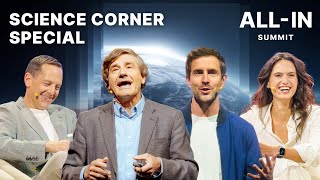
Arm CEO Rene Haas on AI: Nvidia Lessons, Intel’s Decline and the US-China Chip War

Watch on YouTube ↗  |  September 30, 2025 at 17:57  |  25:05  |  All-In Podcast
Speakers
Rene Haas — CEO, Arm
David Sacks — General Partner, Craft Ventures
Chamath Palihapitiya — CEO, Social Capital

Summary

Arm CEO Rene Haas joins the All-In hosts to explain why Nvidia dominates AI training, how Arm CPUs sit alongside every accelerator (Grace Blackwell uses 72 Arm cores), and why inference and edge or physical AI will push compute toward dedicated, energy-efficient chips. He diagnoses Intel's decline as missing mobile and under-investing in EUV, leaving TSMC with a compounding leading-edge flywheel that is hard to catch. The conversation also covers US industrial policy on rare-earth refining and onshore fabs, export controls (David Sacks warns that licensing regimes would slow chip innovation while Haas warns that cutting off China would create a parallel ecosystem), and Haas's optimism about US-China cooperation on AI guardrails.

  • Nvidia's lead stems from GPUs fitting parallel training workloads since AlexNet; competition is emerging from Google TPUs and hyperscaler custom silicon.
  • Arm supplies the CPU alongside AI accelerators, licenses IP for custom chips, and hinted it may go further into building chips itself.
  • Haas expects compute to split into training chips, distilled mixed training-inference chips, and dedicated low-power inference chips at the edge.
  • Physical AI and robotics could become a larger chip market than data centers by unit volume, replacing repurposed automotive ADAS chips.
  • Intel was punished for missing mobile and under-investing in EUV; TSMC's leading-edge customer flywheel compounds and is hard to catch.
  • The rare-earth constraint is refining capacity rather than mineral access, requiring decades-long industrial policy and a rebuilt US manufacturing culture.
  • David Sacks argues export-control licensing regimes would slow semiconductor innovation; Haas says cutting China off would spawn a parallel ecosystem.
  • Haas is optimistic the US and China can cooperate on AI safety guardrails rather than treating AI purely as an arms race.
Ideas
Rene Haas CEO, Arm 4:37
Nvidia owns training; inference fragments
Nvidia's dominance came from the GPU being the best architecture for the massively parallel training workload that emerged with AlexNet and transformers; the first AlexNet work ran on a gaming card, so Nvidia was positioned to seize that moment and it remains the general-purpose leader. But the industry is now asking whether general-purpose or custom chips win: Google builds TPUs, hyperscalers such as xAI and OpenAI are building their own inference silicon, and Haas expects compute to split into training chips, a middle bucket of smaller distilled models mixing training and inference, and dedicated inference chips, because endpoints cannot run a kilowatt GPU. Nvidia's moat is strongest in training while inference becomes much more competitive.
Rene Haas CEO, Arm 5:20
Arm powers every AI accelerator and endpoint
Every AI workload needs a CPU to run the system and drive the accelerator, and Arm is increasingly that CPU: Nvidia's most advanced part, Grace Blackwell, pairs 72 Arm CPUs with Blackwell GPUs, and Arm connects to accelerators from Nvidia, Google and Cerebras alike. Arm also licenses its IP to companies building custom chips, and Haas hinted on the last earnings call that Arm is looking at going further than it does today, possibly into its own silicon. As AI moves from gigawatt data centers into headsets, wearables and robots that need energy-efficient compute, he argues only Arm is positioned to serve that endpoint inference market. Models and software are moving faster than hardware, so customers keep investing in new hardware, which benefits Arm; China's phones and ADAS stacks still run on Android variants and Arm-based designs, which is good for Arm as long as the global ecosystem stays open.
Rene Haas CEO, Arm 9:15
Robot chips will dwarf data-center volume
Haas agrees physical AI will be a gigantic chip market, potentially bigger than data centers on a unit basis. Robots today mostly use repurposed automotive chips built for ADAS functional-safety compliance, which are not designed for actuators or the smaller parts of a joint, so dedicated silicon is needed; each robot will carry tens to hundreds of chips, and on-device AI that can learn makes the unit volume far larger than anything in the market today.
Rene Haas CEO, Arm 12:02
Intel fell behind; catching up is hard
Semiconductors have long product cycles for chips, fabs and architectures, so missing a few cycles gets punished, and Intel has been punished twice: it missed mobile completely, and about a decade ago it chose not to invest in EUV at the rate TSMC did and fell behind in manufacturing. Once you fall behind in chips it is very hard to catch up because the cycle gets on top of you; the leading-edge customers (Apple, Nvidia, AMD) all build at TSMC, so Intel and Samsung do not get the volume that would let them improve, and the gap compounds. Haas sidesteps the US government's roughly 10% stake itself and focuses on the structural deficit.
Rene Haas CEO, Arm 12:25
TSMC's leading-edge flywheel keeps compounding
TSMC now has the best fabs in the world because it invested in EUV a decade ago when Intel did not; Apple, Nvidia and AMD all build their leading-edge chips there, so TSMC keeps getting better at what it builds while Intel and Samsung miss those opportunities, and the flywheel compounds in a way that is very hard for rivals to catch. Arm's own designs are mostly manufactured at TSMC, and its 24/7 operating culture, where technicians and engineers respond immediately when a line goes down, is a muscle the US has lost, which is why the Arizona fab struggled to staff locally.
Up Next

This All-In Podcast video, published September 30, 2025, features Rene Haas discussing NVDA, ARM, Physical AI, INTC, TSM. 5 trade ideas extracted by AI with direction and confidence scoring.

Speakers: Rene Haas  · Tickers: NVDA, ARM, Physical AI, INTC, TSM