Blackstone's Gray on UK Policies, Private Credit, Impact of Iran War
Speakers
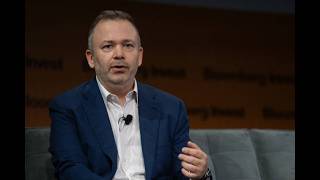
Jon Gray
— President & COO, Blackstone
Francine Lacqua
— Anchor, Bloomberg
Summary
- Geopolitical events (Middle East conflict) cause near-term market volatility and pause in transactions, but Gray expects a reversion to underlying fundamentals (healthy economy, falling inflation) after a "settlement," which should restart deal activity.
- AI is viewed as a "completely transformative" force, with Blackstone investing heavily in the foundational layer: digital infrastructure (data centers) and power/electrical infrastructure.
- Europe offers deal opportunities but is hampered by a slow regulatory environment, which stifles business creation and physical infrastructure build-out (data centers, housing, energy).
- The UK faces near-term headwinds from fiscal policies that may drive out "job creators," though its long-term fundamentals (talent, rule of law) remain strong.
- Private credit risk is "overstated"; structures are far less levered (often <1x) than pre-2008 banks (30-40x), and default rates (low single digits) are below historical norms for non-investment grade credit (~3%). Expects a modest normalization in defaults, not a systemic crisis.
Speakers
Jon Gray
— President & COO, Blackstone
Summary
- Geopolitical shocks like the Middle East conflict cause a temporary pause in deal activity, but fundamentals (falling inflation, strong earnings, eventual rate cuts) will drive a recovery.
- AI is a transformative, all-encompassing theme requiring foundational investment in digital infrastructure and power, and will be applied across all business functions.
- Europe offers opportunities but is hampered by a challenging regulatory environment that slows business creation and infrastructure build-out, particularly for data centers.
- Private credit is fundamentally sound; high leverage comparisons to 2008 are flawed due to lower leverage ratios, longer-dated liabilities, and strong underlying company performance (10% EBITDA growth, 25% debt service coverage improvement).
- The UK faces near-term headwinds from fiscal policies that may drive job creators away, though its long-term strengths remain.
Ideas
"...once the conflict settles, I think oil prices move back down." Gray's base case is that the Middle East conflict will "settle," and the associated risk premium in oil prices will deflate. He views the current high volatility ($30 moves) as temporary. This implies a near-term tactical view that oil prices are elevated due to geopolitics and are likely to fall. A tactical SHORT on oil (via the USO ETF) based on the expectation of geopolitical de-escalation. This is a near-term, event-driven trade. Conflict escalates or spreads, causing a sustained supply shock; OPEC+ intervenes with further production cuts; stronger-than-expected global demand.
"We have a couple of businesses we took public at the end of last year. Medline in hospital supplies, legions [Legrand] in energy management. These stocks are up, you know, 50, 80% because they continue to grow and the market's looking for sort of terra firma companies." The speaker highlights "terra firma" companies—boring, essential businesses with steady growth—as winning in the current market. He uses Legrand (energy management) and Medline (hospital supplies) as specific, successful examples. While Medline is private, Legrand's US ADR (LGRDY) is a direct play. The thesis also applies to other industrial/healthcare essentials like 3M (MMM). This is a thematic call to focus on high-quality, essential industrial and healthcare suppliers. LGRDY is a direct example; MMM is a comparable "terra firma" industrial. This is a WATCH for potential entry. These "boring" stocks may underperform in a rapid, risk-on market rally. Company-specific execution issues.
"We've been the biggest investors in the world in digital infrastructure data centers... that foundation needs to be put in place first... building data centers in Europe is very hard." The speaker identifies data centers as the foundational, physical prerequisite for the AI revolution. Scarcity of supply, especially in constrained markets like Europe, increases the value and pricing power of existing, well-located assets owned by major public REITs. As the dominant private investor (BX) faces hurdles building new supply, the value of existing public data center operators (like DLR, EQIX) is underscored. This is a LONG on the sector leaders. Rapid overbuilding could eventually ease supply constraints. Technological shifts could change data center requirements.
"We're probably the leading investor in power electricity, giving capital to utilities, electrical equipment. I mean, that foundation needs to be put in place first." The AI-driven surge in demand for data centers creates a parallel, non-negotiable demand for massive amounts of reliable electricity. This necessitates huge capital investment in power generation and grid infrastructure, benefiting large, regulated utilities with scale and access to capital. NextEra Energy (NEE) is a premier, large-cap utility positioned to fund and build the necessary power infrastructure, making it a prime beneficiary of this "foundational" AI theme. This is a LONG. Regulatory delays or denials for rate increases or project approvals. Higher interest rates increase capital costs.
"I'd also say there are some businesses in Europe that I think will do quite well. Defence, obviously is going to grow a lot." The speaker explicitly calls out European defence as a growth sector. This is a direct macro call based on the enduring geopolitical tensions he references earlier. It benefits major European defence contractors (BAESY for BAE Systems) and by extension, their US peers (LMT, NOC) in a globally tense environment. This is a straightforward sector call. Geopolitical instability is driving sustained higher defence spending in Europe and globally. This is a LONG on the defence sector. Political budget fights could delay or reduce planned spending. Peaceful resolution of conflicts could reduce urgency.
"It's hard to reconcile that kind of commentary [about private credit being like 2008] with the actual facts we see on the ground... When we do private credit, we either do it unleveraged... or less than one time levered... I don't see... something larger systemic." Gray defends the health of the private credit market, arguing its structural soundness compared to the banking system pre-2008. As the world's largest alternative asset manager and a major private credit player, Blackstone (BX) benefits from sustained growth and a lack of systemic disruption in this high-fee business segment. Market fears are presented as overblown, which, if correct, should support BX's valuation. LONG on Blackstone as the dominant, publicly-traded player positioned to capture growth in private credit, especially if a feared systemic crisis does not materialize. A severe economic downturn that causes private credit defaults to spike well above historical averages; prolonged high interest rates pressuring portfolio companies; significant outflows from its funds.
Up Next



This Bloomberg Markets video, published March 16, 2026, features Jon Gray discussing USO, MMM, LGRDY, EQIX, DLR, NEE, DUK, LMT, BAESY, NOC, BX. 6 trade ideas extracted by AI with direction and confidence scoring.
Speakers: Jon Gray · Tickers: USO, MMM, LGRDY, EQIX, DLR, NEE, DUK, LMT, BAESY, NOC, BX