Conflicting Signals on Timeline and Strategy in Persian Gulf
Speakers
Elisa Ewers
— Senior Fellow, Middle East Studies, Council on Foreign Relations
Steve Yates
— Senior Research Fellow for China and National Security Policy, Heritage Foundation
Summary
- The US administration is sending conflicting signals: President Trump talks of winding down the war while mobilizing additional troops and assets to the Persian Gulf.
- A key policy tool, an OFAC waiver for Iranian oil sales, is interpreted as an attempt to calm and stabilize international oil markets, but its effectiveness is questioned.
- The immediate market response to the war and policy measures has been acute, with prices not stabilizing as intended.
- A new risk dynamic exists in the Strait of Hormuz: Iranian oil continues to move via Chinese and Indian tankers, while other traffic is blocked, increasing costs for global shipping.
- The US effort to rally NATO allies for joint patrols in the Strait is hampered by a pre-existing lack of trust and adversarial rhetoric from the Trump administration towards European capitals.
- European allies possess potential leverage (e.g., linking Strait patrols to support in Ukraine) but are constrained by discomfort with Washington's unpredictability.
- A framing error in analysis is over-weighting short-term public relations versus long-term strategic facts on the ground, such as the degradation of Iranian military capabilities.
- The foundational US policy error, across multiple administrations, is seen as attempting to negotiate and appease the Iranian regime rather than confront it.
Ideas
The speaker stated the war has caused international markets to experience a "shock" and that "a lot of things need to happen to manage that shock," criticizing NATO for acting as a "disinterested bystander." The ongoing conflict and terrorization of a critical chokepoint (Strait of Hormuz) has created a sustained supply shock that requires active, collective management from Western powers, which is currently lacking. The sector is under a persistent threat premium due to geopolitical friction and inadequate institutional response, making its near-term trajectory dependent on the evolution of allied military/diplomatic coordination. A successful, coordinated NATO-led operation to secure the Strait, or a total collapse of Iranian resistance, which would remove the supply threat.
Up Next

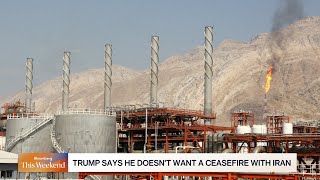



This Bloomberg Markets video, published March 21, 2026, features Elisa Ewers discussing XLE. 1 trade idea extracted by AI with direction and confidence scoring.
Speakers: Elisa Ewers · Tickers: XLE