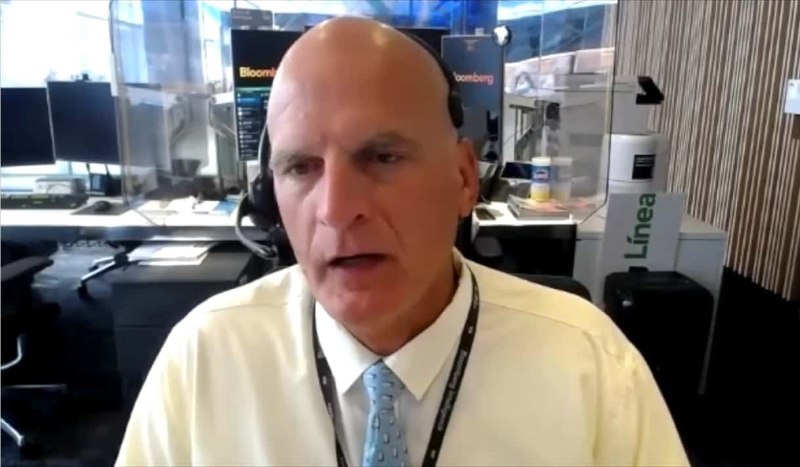
Mike McGlone 6.5 54 ideas

Senior Commodity Strategist, Bloomberg Intelligence
After 1 day
69%winrate
+1.1% avg
24W / 11L · 35/36 ideas
After 1 week
51%winrate
-1.2% avg
18W / 17L · 35/36 ideas
After 1 month
48%winrate
-9.7% avg
11W / 12L · 23/36 ideas
11 winning  /  12 losing  ·  23 positions (30d)
Net: -9.7%
Recent positions
TickerDirEntryP&LDate
USO SHORT $126.85 Apr 14
WTI SHORT $128.35 Mar 30
SPY SHORT $653.28 Mar 20
GOLD SHORT $412.74 Mar 20
SILVER SHORT $61.62 Mar 20
BTC SHORT $70566.90 Mar 20
CL1! SHORT $119.73 Mar 20
SPY SHORT $657.17 Mar 19
SILVER SHORT $64.63 Mar 19
WTI SHORT $119.10 Mar 19
By sector
ETF
32 ideas -9.2%
Commodity
15 ideas -16.4%
Crypto
7 ideas +0.6%
Top tickers (by frequency)
USO 7 ideas
0% W -40.1%
WTI 6 ideas
0% W -44.0%
SPY 5 ideas
100% W +2.2%
BTC 5 ideas
50% W -1.5%
XLE 4 ideas
50% W -2.0%
Best and worst calls
December WTI oil contract to head toward $50.
The oil market is viewing the Strait of Hormuz blockade as a temporary obstacle; U.S. supply is increasing and will lead to demand destruction, with the December WTI contract expected to fall toward $50 as the market adjusts and the political/military situation is resolved.
USO HIGH Bloomberg Markets Apr 14, 00:02
Senior Commodity...
The speaker identifies a "pump and dump" trend in commodities (NatGas, Silver, Gold, Copper) and states Crude Oil is "next in line." He is fixating on the December Crude Oil future, trading near $95, and warns high oil can crush the global economy and lead to a notable recession. A sharp, sustained rise in oil prices shuts down consumer sentiment and capital spending, which historically precedes economic contractions and market declines. WATCH due to the high potential for a significant price reversal ("dump") following its massive rally, which could precipitate broader economic weakness. The Strait of Hormuz remains closed or conflict escalates, preventing the anticipated supply normalization and price decline.
WTI Bloomberg Markets Mar 31, 23:26
Senior Commodity...
McGlone states that by the time of the midterm elections, the December WTI crude contract is "more likely to be 50 than 100," and that "100 is a recession, 50 is normal." He argues the market is already sniffing out post-inflation deflation in futures, producers are bringing on supply to capitalize on high prices, and political incentives (Trump needing lower prices by midterms) will align to push prices lower. SHORT because he expects a significant decline from elevated levels near $113 toward $50. Further military escalation in the Middle East severely disrupts supply, countering the deflationary supply response.
WTI Bloomberg Markets Mar 30, 17:31
Senior Commodity...
Speaker states, "I'm not a fan of gold. I think initially goes to 4,000." He asserts the bull market is over and it is no longer a store-of-value asset. Gold's 2025 parabolic rally transformed it into a high-volatility speculative asset (180-day vol at 2.4x S&P 500). It went "up too much" and now exhibits classic commodity behavior where extreme price spikes are followed by mean reversion. A falling stock market will drag down all high-volatility assets. The fundamental characteristic of the asset has changed from defensive to speculative, making it vulnerable in a broad market downturn. The geopolitical crisis escalates far beyond expectations, reigniting a flight to traditional havens and overriding the volatility/momentum dynamics.
GOLD The David Lin Report Mar 20, 23:47
Senior Commodity...
Speaker states, "I still think Bitcoin is going to head towards 10,000," with initial key support at $50,000. Bitcoin led the risk asset rally and is now leading the decline. Its peak coincided with the "biggest ETF launch in history," a classic contrary sell signal. It is now part of a crowded, financialized market with an "unlimited supply" of competing cryptocurrencies that need a purge (e.g., Dogecoin at $15B). As a leading indicator for risk appetite, its breakdown presages a broader stock market correction which will feed back into further crypto declines. A sudden, massive wave of institutional adoption unrelated to macro conditions provides a new, independent source of buy-side pressure.
BTC The David Lin Report Mar 20, 23:47
Senior Commodity...
Speaker explicitly says, "I fully expect silver to go back to near 50," referencing its drop from a year-to-date high above $100. As an industrial metal, silver is even more exposed to the coming recession than gold. Its dramatic 63% YTD pump has already reversed into a dump, showing the pattern. High prices will lead to "thrifting" (demand destruction) and bring on new supply. The "devil's metal" has lived up to its reputation for sharp reversals. Its extreme price action signals a major top. A rapid, V-shaped global economic recovery that sparks immediate industrial demand before supply can respond.
SILVER The David Lin Report Mar 20, 23:47
Senior Commodity...
Speaker calls this "the beginning of the third 50% draw down in the S&P 500 since 2000," stating the market is overdue for a 20%+ correction. The market is at its most expensive level versus GDP (~2.3x) in nearly 100 years, while 180-day volatility is near 10-year lows, indicating extreme complacency. The oil shock and potential Fed policy error are the catalysts for a violent mean reversion. The economy is now the stock market, so a downturn directly causes recession. A normal reversion is "way overdue," and the current crisis provides the trigger. High valuation is the number one reason for a recession. The Strait of Hormuz reopens quickly without sustained economic damage, and the Fed successfully navigates with patience, allowing the AI-driven valuation narrative to reassert itself.
SPY The David Lin Report Mar 20, 23:47
Senior Commodity...
Speaker explicitly states he expects WTI crude oil to drop towards $40-$50 per barrel by the end of the year, calling for the December 2026 contract (trading ~$77) to move toward $50. The Strait of Hormuz closure is an inflationary oil shock that will trigger a global recession, which is historically deflationary for commodities. High prices will destroy demand, spur a flood of supply from the Western Hemisphere, and accelerate the shift to alternatives (e.g., EVs). The asset is its own worst enemy; the current "pump" will inevitably lead to a "dump" as it did in 2008 ($147 to $32) and 2022 ($130 to $55). The Strait remains closed indefinitely, or the U.S./Israeli military fails to re-open it and neutralize Iran's offensive capabilities, prolonging the supply crisis.
CL1! The David Lin Report Mar 20, 23:47
Senior Commodity...
Speaker explicitly stated that crude oil peaked at $147 in July 2008 with CPI at 5.6%, fell to $32 by year-end, and he thinks this pattern is happening now. High oil prices from the ongoing energy crisis will likely lead to a global recession and deflation, causing oil prices to collapse as in 2008. SHORT crude oil due to the expected significant price drop driven by recessionary forces. If the energy crisis abates quickly without causing a recession, oil prices might remain elevated.
WTI Bloomberg Markets Mar 19, 18:12
Senior Commodity...
Speaker noted that silver was up 63% in January but is now down almost 3% year-to-date, and said "this is just getting started." Metals are collapsing due to deflationary recessionary forces emanating from the energy crisis, indicating further downside. SHORT silver as further decline is expected based on the speaker's direct commentary. If deflationary forces do not materialize or geopolitical tensions escalate anew, silver could rebound.
SILVER Bloomberg Markets Mar 19, 18:12
Senior Commodity...
Speaker mentioned that 60-day volatility on the S&P 500 is still down on the year despite commodity volatility, and observed "wobbling" in the stock market. Historical patterns (e.g., post-9/11) show that commodity crises can transmit volatility to equities, leading to declines; current energy crisis is likely to trigger similar effects. SHORT S&P 500 due to the anticipated downturn from the trickle-up of commodity volatility and recessionary fears. If commodity volatility subsides without impacting corporate earnings or investor sentiment, stocks might avoid a downturn.
SPY Bloomberg Markets Mar 19, 18:12
Senior Commodity...
McGlone stated the closure of the Strait of Hormuz is causing a "global energy crisis" and a "potential recession," with U.S. diesel topping $5/gallon and jet fuel prices doubling. The sustained blockage of a critical oil chokepoint is drastically reducing supply and spiking global fuel prices, which acts as a tax on the entire economy and can lead to demand destruction. WATCH because the situation is a clear price catalyst with recessionary implications, but the timeline for resolution is highly uncertain and prices may auto-correct if demand falls sharply. The Strait of Hormuz reopens sooner than expected, or a global economic slowdown destroys demand faster than supply is constrained.
XLE Bloomberg Markets Mar 18, 00:44
Senior Commodity...
McGlone highlighted the fertilizer crisis, noting there is "no strategic reserve," and linked it to corn, where the cost of production is below $4/bushel but prices are nearing $5. Fertilizer is a critical agricultural input. Supply disruption from the Middle East crisis threatens crop yields and production costs. High input costs can spark a short-term price spike in key grains like corn, but may also accelerate a subsequent price collapse if demand drops. WATCH because the input cost shock creates volatility and near-term upside pressure in agricultural commodities, but the thesis is contingent on the conflict's duration and eventual demand response. The fertilizer supply chain is quickly rerouted, or a major crop forecast indicates overwhelming supply (like the U.S. superabundance McGlone mentioned).
XLB Bloomberg Markets Mar 18, 00:44
Senior Commodity...
"The Strait being closed is a shocker... When it spikes like this, it can be its own worst enemy. It can bring on a global energy crisis..." The physical blockage of one of the world's most critical energy chokepoints removes millions of barrels from the global market daily, forcing a sustained premium on crude prices and directly benefiting domestic energy producers who are insulated from the blockade. LONG. Until military intervention successfully clears the Strait, the structural supply deficit will keep oil prices and energy sector margins elevated. The high price of oil causes demand destruction faster than expected, leading to a global recession that ultimately crashes energy prices (similar to the 2008 cycle).
USO Bloomberg Markets Mar 12, 23:55
Senior Commodity...
"Last year gold had its best year since 1979. It was front running this event... It is tilting that way, this might be the beginning of a post inflation, deflationary period." As the oil shock threatens to trigger a global recession and equity market volatility, investors will flee risk assets and rotate into traditional safe-haven assets to preserve capital. LONG. Gold serves as a dual hedge against both the immediate geopolitical chaos in the Middle East and the subsequent deflationary recession risk caused by the energy spike. The conflict is resolved quickly, leading to a risk-on rally in equities, a drop in oil prices, and a selloff in safe-haven assets.
GLD Bloomberg Markets Mar 12, 23:55
Senior Commodity...
Mike McGlone (Senior Commodity Strategist, Bloomberg Intelligence) | 54 trade ideas tracked | USO, WTI, SPY, BTC, XLE | YouTube | Buzzberg