BUZZBERGThe leaderboard is ranked by Alpha Score, which weighs a speaker's average return, their number of calls, and reputation — a credibility rating of the source that can only raise a score, never lower it.Read the FAQ
Lutnick confirms the administration is pursuing semiconductor tariffs where companies that build in America get relief and companies that do not pay tariffs; he cites $1.2 trillion of US semiconductor commitments, a shift from under 2% to 40-50% US production, TSMC's $265B Arizona factory, Micron's $250B memory factories, and expects Intel to succeed.
Lutnick confirms the administration is pursuing semiconductor tariffs where companies that build in America get relief and companies that do not pay tariffs; he cites $1.2 trillion of US semiconductor commitments, a shift from under 2% to 40-50% US production, TSMC's $265B Arizona factory, Micron's $250B memory factories, and expects Intel to succeed.
Lutnick confirms the administration is pursuing semiconductor tariffs where companies that build in America get relief and companies that do not pay tariffs; he cites $1.2 trillion of US semiconductor commitments, a shift from under 2% to 40-50% US production, TSMC's $265B Arizona factory, Micron's $250B memory factories, and expects Intel to succeed.
Lutnick says the administration wants to replicate its semiconductor buildout approach in nuclear: launch a clear factory build in America during Trump's term, making nuclear part of the advanced manufacturing push alongside semiconductors and pharmaceuticals.
Lutnick argues that data centers create huge economics for surrounding communities and that criticism of their water use is propaganda by adversaries meant to slow the US down; he says communities that invite data centers will win and be better off.
Massive private AI infrastructure investments in US.
Secretary Lutnick says the Trump administration is attracting enormous private AI infrastructure investment: Nvidia committed $500 billion to AI infrastructure and supercomputers, TSMC $265 billion to semiconductor manufacturing, IBM over $150 billion, Micron $250 billion for memory fabs, plus SpaceX and Anthropic commitments, signaling a broad US AI infrastructure buildout.
Massive private AI infrastructure investments in US.
Secretary Lutnick says the Trump administration is attracting enormous private AI infrastructure investment: Nvidia committed $500 billion to AI infrastructure and supercomputers, TSMC $265 billion to semiconductor manufacturing, IBM over $150 billion, Micron $250 billion for memory fabs, plus SpaceX and Anthropic commitments, signaling a broad US AI infrastructure buildout.
Rare earths are strategic decoupling beneficiaries
Lutnick says critical minerals and rare earths are a key way for the United States to separate from China because China is weaponizing them against the US economy; domestic rare earth and magnet companies are strategically important.
Lutnick confirms the administration is pursuing semiconductor tariffs where companies that build in America get relief and companies that do not pay tariffs; he cites $1.2 trillion of US semiconductor commitments, a shift from under 2% to 40-50% US production, TSMC's $265B Arizona factory, Micron's $250B memory factories, and expects Intel to succeed.
Lutnick expects the bond market to stabilize better than people imagine because restored tariffs will generate $300B-400B a year, reduce the budget deficit, lift GDP growth back above 3%, and the Iran economic pressure will be effective; he expects rates to stabilize and decline over the next six months.
Lutnick defends the weakening dollar (down 10%) as a correction that aids exports, stating, "We are exporting more... that's why our GDP has grown." He predicts "enormous manufacturing job growth." A Commerce Secretary explicitly endorsing a weaker dollar is a green light for large US exporters. A cheaper dollar makes American heavy machinery and engines more competitive globally against foreign rivals. LONG Industrials (Caterpillar, GE) that benefit from FX tailwinds and pro-manufacturing trade policies. Inflationary pressure from import costs (tariffs).
Lutnick defends the weakening dollar (down 10%) as a correction that aids exports, stating, "We are exporting more... that's why our GDP has grown." He predicts "enormous manufacturing job growth." A Commerce Secretary explicitly endorsing a weaker dollar is a green light for large US exporters. A cheaper dollar makes American heavy machinery and engines more competitive globally against foreign rivals. LONG Industrials (Caterpillar, GE) that benefit from FX tailwinds and pro-manufacturing trade policies. Inflationary pressure from import costs (tariffs).
When asked about Tether, Lutnick states, "I believe US dollar backed stablecoins should be fully audited." Senator Reed criticizes the "Genius Act" loopholes for unaudited offshore coins. The administration is signaling a crackdown on offshore/unaudited stablecoins (Tether) while favoring regulated, audited US alternatives. This regulatory moat favors compliant US-based crypto infrastructure. LONG Coinbase (issuer of USDC, the compliant alternative) as regulatory pressure mounts on Tether. Over-regulation stifling the broader crypto market.
When asked about Tether, Lutnick states, "I believe US dollar backed stablecoins should be fully audited." Senator Reed criticizes the "Genius Act" loopholes for unaudited offshore coins. The administration is signaling a crackdown on offshore/unaudited stablecoins (Tether) while favoring regulated, audited US alternatives. This regulatory moat favors compliant US-based crypto infrastructure. LONG Coinbase (issuer of USDC, the compliant alternative) as regulatory pressure mounts on Tether. Over-regulation stifling the broader crypto market.
Lutnick defends the weakening dollar (down 10%) as a correction that aids exports, stating, "We are exporting more... that's why our GDP has grown." He predicts "enormous manufacturing job growth." A Commerce Secretary explicitly endorsing a weaker dollar is a green light for large US exporters. A cheaper dollar makes American heavy machinery and engines more competitive globally against foreign rivals. LONG Industrials (Caterpillar, GE) that benefit from FX tailwinds and pro-manufacturing trade policies. Inflationary pressure from import costs (tariffs).
Lutnick defends the weakening dollar (down 10%) as a correction that aids exports, stating, "We are exporting more... that's why our GDP has grown." He predicts "enormous manufacturing job growth." A Commerce Secretary explicitly endorsing a weaker dollar is a green light for large US exporters. A cheaper dollar makes American heavy machinery and engines more competitive globally against foreign rivals. LONG Industrials (Caterpillar, GE) that benefit from FX tailwinds and pro-manufacturing trade policies. Inflationary pressure from import costs (tariffs).
Lutnick highlights Kansas's broadband plan, noting they achieved coverage with "67% fixed wireless" and only "29.5% fiber," calling it the "best performing service" for the price. The federal government is officially validating Fixed Wireless Access (FWA) as a primary solution for rural broadband, moving away from the previous administration's fiber-optic obsession. This reduces capex pressure on fiber builds and validates the business model of FWA providers. LONG T-Mobile (leader in 5G Home Internet/FWA) as the primary beneficiary of federal grant dollars shifting toward wireless solutions. Capacity constraints on 5G networks in rural areas.
Lutnick highlights Kansas's broadband plan, noting they achieved coverage with "67% fixed wireless" and only "29.5% fiber," calling it the "best performing service" for the price. The federal government is officially validating Fixed Wireless Access (FWA) as a primary solution for rural broadband, moving away from the previous administration's fiber-optic obsession. This reduces capex pressure on fiber builds and validates the business model of FWA providers. LONG T-Mobile (leader in 5G Home Internet/FWA) as the primary beneficiary of federal grant dollars shifting toward wireless solutions. Capacity constraints on 5G networks in rural areas.
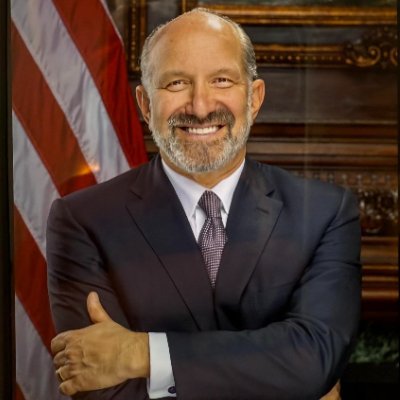
Howard Lutnick has 14 trade ideas tracked on Buzzberg across 14 tickers since February 2026. Ranked #607 on the Buzzberg Alpha leaderboard. Most covered: MU, INTC, TSM.
#607Ranked Speaker
#607 of 1818 voices on Buzzberg