BUZZBERGAlpha Score combines three things: realized average return, confidence in the sample size, idea volume, and speaker reputation. Speakers with only a few calls are pulled closer to the platform average; speakers with many evaluated ideas keep more of their own return. Reputation only boosts: 5.0 or lower is neutral, while scores above 5 add weight. Scores are normalized to 0-100; 100 is best.Read the FAQ
Despite market jitters, hyperscalers (Google, etc.) are spending $80B+ on capex, and Microsoft is seeing high adoption of AI agents. The sell-off in AI names is a "digestion phase." The spending is not vanishing; it is accelerating. The winners are the "platform" companies (Nvidia, Microsoft) that provide the foundation for the application layer. LONG Big Tech AI leaders on the pullback. "Air pocket" in demand if AI applications fail to generate ROI quickly, leading to a capex cut.
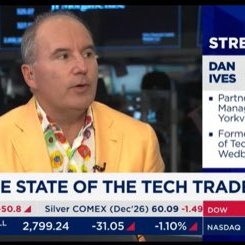
Microsoft remains the backbone of the AI revolution despite concerns over capital expenditure (Capex). Microsoft was downgraded by Melius (claiming Satya Nadella "lost the AI narrative"), but Ives predicts the stock will have a "5" or "6" in front of it ($500-$600) in the next 12-24 months. The AI revolution cannot succeed unless Microsoft succeeds because they own the enterprise entry point via Azure. While investors worry about massive spending (Capex) to catch up to Google/Amazon, Ives believes Microsoft won't need to spend as drastically as feared and has only monetized 5% of its base so far. Deep integration into enterprise backyards via Azure. Near-term sentiment is negative ("guilty until proven innocent") regarding free cash flow hits from spending.
Enterprise software giants are currently mispriced due to exaggerated fears of AI disruption. Ives has moved Salesforce (CRM) and ServiceNow (NOW) into his "AI 20" list. He notes Salesforce is trading at ~15x earnings, which he views as a massive dislocation. The market currently believes AI will "disintermediate" (replace) these companies. Ives argues the opposite: AI will be integrated *into* their stacks, driving 20-30% incremental revenue that is not currently factored into their stock prices. He views the sell-off as the "most disconnected call" of his career. Ives conducted "stress tests" by speaking to 40-50 CTOs and IT managers, confirming that these platforms remain essential to enterprise stacks. The market continues to view them as "guilty until proven innocent" regarding their ability to grow amidst AI competition.
These companies represent the next wave of AI "use cases" following the hardware build-out. Ives lists these names as the leaders in the software phase of AI, following the initial GPU/Data Center phase. As the AI build-out progresses from buying chips to actually using applications, data analytics and management platforms become critical. He sees the wave moving from Palantir (PLTR) to Snowflake (SNOW) and MongoDB (MDB). N/A (General sector rotation thesis). High valuation multiples compared to legacy software.
"AMD is going to play a huge role. Micron is going to play a role. You will go down like in terms of TSMC and just the whole derivatives on the supply chain." While Nvidia is "Michael Jordan," the market is large enough for a "Scottie Pippen" (AMD). Furthermore, the sheer volume of CapEx spending requires massive amounts of memory (Micron) and fabrication capacity (TSMC), creating a rising tide for the entire hardware supply chain. Buy the ecosystem derivatives that support the AI buildout. These companies are "second fiddle" to Nvidia; if Nvidia sneezes, these stocks may catch a cold.
These companies represent the next wave of AI "use cases" following the hardware build-out. Ives lists these names as the leaders in the software phase of AI, following the initial GPU/Data Center phase. As the AI build-out progresses from buying chips to actually using applications, data analytics and management platforms become critical. He sees the wave moving from Palantir (PLTR) to Snowflake (SNOW) and MongoDB (MDB). N/A (General sector rotation thesis). High valuation multiples compared to legacy software.
Cybersecurity is another sector unfairly punished by negative sentiment. Ives groups Palo Alto Networks (PANW) and CrowdStrike (CRWD) with Salesforce as names that are "dislocated" from their true opportunity. Similar to the enterprise software thesis, the market is underestimating the necessity of these tools in an AI-driven world. Ives views the current dip as a buying opportunity based on customer demand checks. Feedback from CTOs and CISOs (Chief Information Security Officers) indicates strong ongoing demand. Continued sector rotation out of high-multiple software names.
Ives calls the recent software selloff ("SaaS Apocalypse") a "knee-jerk" reaction. He notes hyperscalers are committing $650B+ to CapEx this year. The market is wrongly assuming AI models (Anthropic/OpenAI) will replace enterprise software. In reality, AI requires the "hearts and lungs" of established data layers (Salesforce, ServiceNow, Oracle) to function. Ives cites a multiplier effect: for every $1 spent on NVDA, $8-10 will eventually flow to software/infrastructure. LONG. Buy the dip in marquee software names and cloud infrastructure providers. Enterprise spending slowdowns or faster-than-expected displacement of legacy SaaS by AI agents.
AI demand accelerating, bullish for hardware and hyperscalers.
During a two-week trip to Asia, Ives observed that demand for AI is accelerating and there are no cracks in the AI buildout. This is bullish for hardware players, hyperscalers (Microsoft, Google, Amazon), and the software trade, as it indicates strong earnings and monetization. He calls it a 'bright green light' going into earnings season.
Tesla is focused on autonomous robotics and is a key AI play, with potential future merger with SpaceX, making it a bullish investment despite near-term demand challenges.
Ives calls the recent software selloff ("SaaS Apocalypse") a "knee-jerk" reaction. He notes hyperscalers are committing $650B+ to CapEx this year. The market is wrongly assuming AI models (Anthropic/OpenAI) will replace enterprise software. In reality, AI requires the "hearts and lungs" of established data layers (Salesforce, ServiceNow, Oracle) to function. Ives cites a multiplier effect: for every $1 spent on NVDA, $8-10 will eventually flow to software/infrastructure. LONG. Buy the dip in marquee software names and cloud infrastructure providers. Enterprise spending slowdowns or faster-than-expected displacement of legacy SaaS by AI agents.
These companies represent the next wave of AI "use cases" following the hardware build-out. Ives lists these names as the leaders in the software phase of AI, following the initial GPU/Data Center phase. As the AI build-out progresses from buying chips to actually using applications, data analytics and management platforms become critical. He sees the wave moving from Palantir (PLTR) to Snowflake (SNOW) and MongoDB (MDB). N/A (General sector rotation thesis). High valuation multiples compared to legacy software.
The Nasdaq 100 is the preferred way to play the AI build-out because earnings have demonstrated consistent improvement and fundamentals have room to grow; the earnings-driven market supports further upside.
