By the time you find out what Stanley Druckenmiller, David Tepper or Bill Ackman bought, the trade may already be months old.
Their 13F filings show certain holdings at the end of each quarter, with reports generally due up to 45 days later. A filing published in February can tell you what a manager owned on December 31. In the meantime, they may have added to the position, reduced it or sold it entirely. SEC explanation of 13F filings.
Professional investors face a demanding benchmark: 79% of active U.S. large-cap equity funds trailed the S&P 500 in 2025, according to S&P's article on its SPIVA research. That study covers active equity funds; here, we wanted to examine the disclosed holdings of a selected group of widely followed investors.
What happens if you buy after their holdings become public? And could those filings help you discover a company worth researching while there is still substantial opportunity ahead?
We reconstructed five years of disclosed portfolios, updated each copy after its filings became available, and compared the results with the S&P 500 over the same dates. We then examined individual ideas that a reader could have discovered through those reports.
Druckenmiller's Duquesne copy gained an estimated 188.4%, versus 82.8% for the benchmark. Appaloosa and Atreides also finished ahead. Several other well-known portfolios did not.
For the individual ideas, we measured share-price gains from public disclosure through September 14, 2026, assuming a reader kept the stock. For the complete portfolios, we followed the changes in subsequent filings.
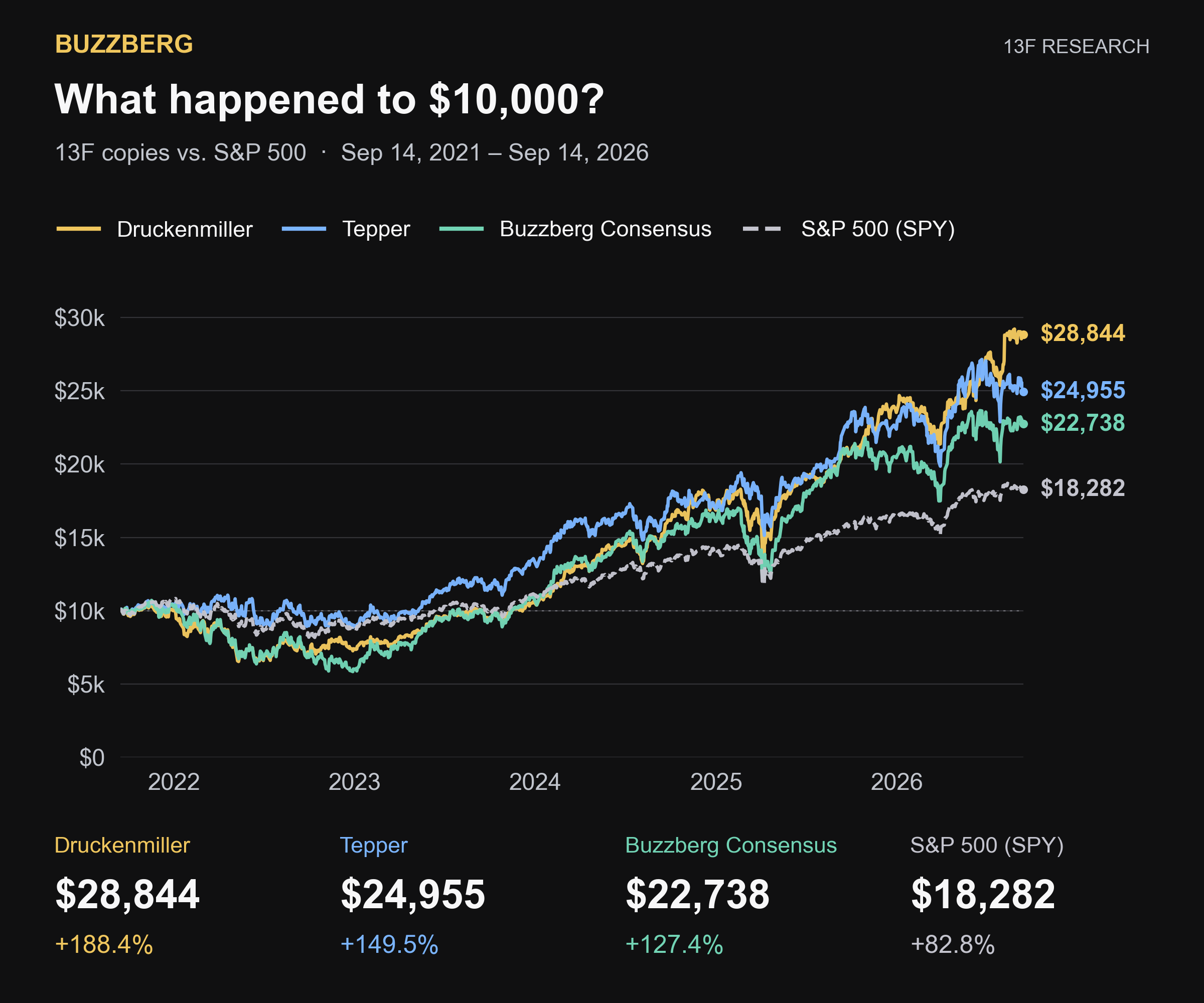
Four selected portfolios, starting with the same $10,000. The full comparison follows below.
Which portfolios beat the S&P 500?
The comparison runs from September 14, 2021, to September 14, 2026. We use SPY as the S&P 500 benchmark, measured over exactly the same dates.
For each manager, the model waits until a filing becomes public, then copies the disclosed long positions at an eligible closing price. It holds them until the next filing triggers an update. The returns below are hypothetical estimates before trading costs, based on disclosed long holdings. They exclude shorts, leverage and private investments and do not represent the manager's actual fund performance.
| Portfolio copied | Five-year return | Ahead of / behind SPY | Largest decline from a previous peak |
|---|---|---|---|
| Duquesne — Stanley Druckenmiller | +188.4% | +105.6 pp | −37.6% |
| Appaloosa — David Tepper | +149.5% | +66.7 pp | −22.1% |
| Atreides — Gavin Baker | +131.8% | +49.0 pp | −49.7% |
| Berkshire Hathaway | +77.6% | −5.3 pp | −23.7% |
| Renaissance Technologies | +64.0% | −18.8 pp | −19.0% |
| Citadel Advisors | +52.5% | −30.3 pp | −21.5% |
| Pershing Square | +50.0% | −32.8 pp | −30.0% |
| Viking Global | +38.7% | −44.1 pp | −40.9% |
| Tiger Global | +18.1% | −64.7 pp | −62.4% |
| Baupost | +7.9% | −74.9 pp | −36.1% |
| Buzzberg Consensus Top 10 | +127.4% | +44.6 pp | −45.4% |
| S&P 500 benchmark — SPY | +82.8% | — | approximately −24.5% |
Source: Buzzberg Callfolio, September 14, 2026. “pp” means percentage points.
The spread is substantial. A hypothetical $10,000 became roughly $28,844 in the Duquesne copy, $24,955 in Appaloosa and $18,282 in SPY.
The final column changes how some of those results look. Atreides beat the benchmark but experienced a decline of almost 50% along the way. Appaloosa combined a higher ending return with a considerably smaller worst decline in this sample.
You can explore the copied portfolios and their disclosed holdings in Buzzberg Callfolio.
Stanley Druckenmiller: spotting NVIDIA and Vertiv early
Stanley Druckenmiller already owned NVIDIA at the end of 2022. If you were following his filings, you could have picked up the idea on February 14, 2023, when Duquesne disclosed the position. NVIDIA closed that day at approximately $22.97, adjusted for the later stock split. Duquesne's year-end 2022 filing.
By September 14, 2026, it was $210.96. Buying after the disclosure and holding would have turned $1,000 into approximately $9,184, a gain of 818%, versus 84% for SPY over the same dates.
This is a useful reason to follow an investor like Druckenmiller. His filing could have prompted you to investigate NVIDIA in early 2023, with much of that subsequent rise still ahead. The reporting delay left plenty of room in this particular investment.
Vertiv was visible even earlier: Duquesne's September 2022 holdings, published that November, included the company. The November disclosure. Several other ideas also went on to produce substantial gains:
| Stock | Entry after public disclosure | Price gain to Sept. 14, 2026 | SPY, same dates |
|---|---|---|---|
| NVIDIA | Feb. 14, 2023 | +818.4% | +84.4% |
| Vertiv (VRT) | Nov. 14, 2022 | +1,490.0% | +92.6% |
| Natera (NTRA) | Nov. 14, 2022 | +863.9% | +92.6% |
| Seagate Technology (STX) | Nov. 14, 2023 | +979.7% | +69.6% |
| Palantir (PLTR) | May 15, 2024 | +699.8% | +43.6% |
| Eli Lilly (LLY) | Aug. 15, 2022 | +262.6% | +77.4% |
| Microsoft (MSFT) | May 15, 2023 | +63.3% | +84.2% |
Vertiv makes power and cooling equipment for data centers. Following Duquesne would have put this part of the computing infrastructure on your radar in November 2022, when the stock cost about $14.93. It reached $237.39 by our cutoff — approximately 1,490% higher. NVIDIA and Vertiv show how the same set of filings could introduce a reader to different businesses serving the demand for computing. What Vertiv does.
Natera is a different kind of business: a genetic-testing company working in areas including cancer, reproductive health and organ health. That position first appeared at roughly 1% of Duquesne's disclosed long portfolio and had grown to about 19.9% by June 2026. About Natera.
Druckenmiller later sold NVIDIA: it was absent from the report published in November 2024. A reader could have found the idea through him and chosen to keep it longer. Microsoft, meanwhile, gained less than the index over the period shown.
David Tepper: NVIDIA, Micron and TSMC after the filings
Appaloosa disclosed a NVIDIA position in May 2023, followed by Micron and Taiwan Semiconductor positions in August. The June report showed that Tepper had increased the NVIDIA holding to 1.02 million shares from 150,000 in the preceding quarter. Appaloosa's June 2023 filing.
An investor buying after those reports and holding through September 14, 2026 would have seen:
| Stock | Entry after public disclosure | Price gain | SPY, same dates |
|---|---|---|---|
| NVIDIA | May 16, 2023 | +622.1% | +85.5% |
| Micron | Aug. 15, 2023 | +1,314.4% | +71.8% |
| Taiwan Semiconductor | Aug. 15, 2023 | +355.9% | +71.8% |
Micron began at about 1.6% of Appaloosa's disclosed long portfolio in June 2023 and represented approximately 15.1% by June 2026. Following the reports would have put that investment on a reader's radar years before the endpoint in this table.
The complete Appaloosa copy, including its other positions and later allocation changes, returned 149.5% over our five-year window.
Bill Ackman: Alphabet after the AI concerns
Bill Ackman started buying Alphabet in early 2023 while investors worried that AI would threaten its search business. Pershing Square saw an opportunity: the company had substantial AI capabilities of its own. Institutional Investor's account of the investment.
The holding became public on May 15, 2023. A reader buying GOOG at the next day's close would have paid approximately $120.09. At our September 14, 2026 cutoff, it was $345.71: a gain of about 188%, versus 85% for SPY. Alphabet's two share classes initially represented approximately 10.4% of Pershing's disclosed long portfolio. The original disclosure.
Pershing later exited the position, but the 2023 report had already given readers a chance to investigate Alphabet while much of its subsequent rise was still ahead.
The full Pershing Square copy returned 50.0% over five years, behind SPY's 82.8%. An individual idea can therefore be useful even when copying the entire portfolio would have underperformed.
Netflix illustrates the delay more sharply. Ackman announced that he had sold the position on April 20, 2022. The March-end holding then appeared in the 13F published on May 16, almost a month after that announcement. Someone relying only on the new filing could have bought a stock he had already sold. Pershing Square's sale announcement.
Gavin Baker's Atreides: finding the companies behind AI infrastructure
Atreides is led by Gavin Baker, its founder and chief investment officer. His reports offer a way to look beyond the most familiar technology stocks and find the companies supplying the underlying infrastructure. Baker's background.
Astera Labs is a good example. The company makes connectivity chips for cloud and AI infrastructure and began trading publicly on March 20, 2024. By March 31, Atreides held approximately 2.7 million shares. Readers could see that position in the filing published on May 15. The company had been public for less than two months. Astera's IPO and business, Atreides' March 2024 holdings.
The same report included Lumentum, an optical-components supplier. Coherent, another supplier of optical technology, had appeared in the September 2023 holdings published that November. Both make products used to move data through computing networks. The Coherent disclosure, Lumentum, Coherent.
Buying after those disclosures and holding through September 14, 2026 gives the following comparison:
| Stock | Entry after disclosure | Price gain | SPY, same dates |
|---|---|---|---|
| Coherent (COHR) | Nov. 15, 2023 | +638.2% | +69.2% |
| Astera Labs (ALAB) | May 16, 2024 | +252.1% | +43.9% |
| Lumentum (LITE) | May 16, 2024 | +1,684.3% | +43.9% |
The timing is interesting. NVIDIA announced investments of $2 billion each in Coherent and Lumentum on March 2, 2026. A reader following Baker's earlier filings could have investigated both companies well before those announcements. NVIDIA's Coherent announcement, Lumentum announcement.
The complete Atreides copy gained 131.8% over five years, with a largest decline of 49.7%.
Brad Gerstner's Altimeter: NVIDIA and Astera early in their runs
Altimeter was founded by Brad Gerstner, who serves as its CEO. Its disclosures offer another view into technology investing. Gerstner's background.
Like Duquesne, Altimeter already held NVIDIA at the end of 2022. Its February 14, 2023 filing reported 442,670 shares. Because this filing arrived after the market closed, our entry falls on February 15, at approximately $22.76 per split-adjusted share. Altimeter's year-end 2022 disclosure.
Altimeter also held 400,000 Astera Labs shares at the end of March 2024, its first quarter as a public company. That position was disclosed on May 15, the same day as Atreides' holding. Following either manager could have put Astera on your research list at that point. Altimeter's March 2024 holdings.
| Stock | Entry after disclosure | Price gain to Sept. 14, 2026 | SPY, same dates |
|---|---|---|---|
| NVIDIA | Feb. 15, 2023 | +826.7% | +83.8% |
| Astera Labs (ALAB) | May 16, 2024 | +252.1% | +43.9% |
Following Gerstner would have given you two concrete research leads: NVIDIA in early 2023 and Astera shortly after its IPO. From there, the useful work is to understand the business, the demand it serves and what the share price already assumes. A disclosed holding provides a reason to investigate; deciding whether to buy and how long to hold requires your own view.
Buzzberg Consensus: what would you have bought in 2023?
Sometimes an idea becomes more interesting when several investors own it. The Buzzberg Consensus Top 10 collects the stocks held by the largest number of tracked managers. Each stock starts at 10%, and the list is updated as new filings become public.
NVIDIA entered the reconstructed consensus on May 15, 2023, when six tracked portfolios held it. The closing price was approximately $28.95, adjusted for the later stock split. That was nine days before NVIDIA published its May 24 results and forecast $11 billion in revenue for the next quarter, highlighting demand for accelerated computing and generative AI. NVIDIA's May 2023 results.
An investor who used that consensus entry to identify NVIDIA, bought at the May 15 close and held through September 14, 2026 would have gained approximately 629%, versus 84% for SPY. This is the return on that individual idea; the full consensus portfolio also held other stocks and rebalanced over time.
By the May 16, 2023 update, the ten positions were Meta, Microsoft, Amazon, Snowflake, NVIDIA, Uber, Alphabet Class A, Visa, Apple and Alphabet Class C. Alphabet occupied two positions because the model ranks listed share classes separately.
That list gave a reader several ways to investigate the development of AI: NVIDIA's computing hardware, the cloud businesses at Microsoft and Amazon, and the software and platforms at Snowflake, Meta and Alphabet. The filings showed that managers held these businesses; they did not tell us that every manager bought them for the same AI thesis.
You can inspect the reconstructed holdings and updates in Buzzberg Callfolio.
The complete Consensus Top 10 gained an estimated 127.4% over the five-year comparison, versus 82.8% for SPY. Its largest decline from a previous peak was 45.4%, so the overlap between managers did not make it a low-volatility portfolio.
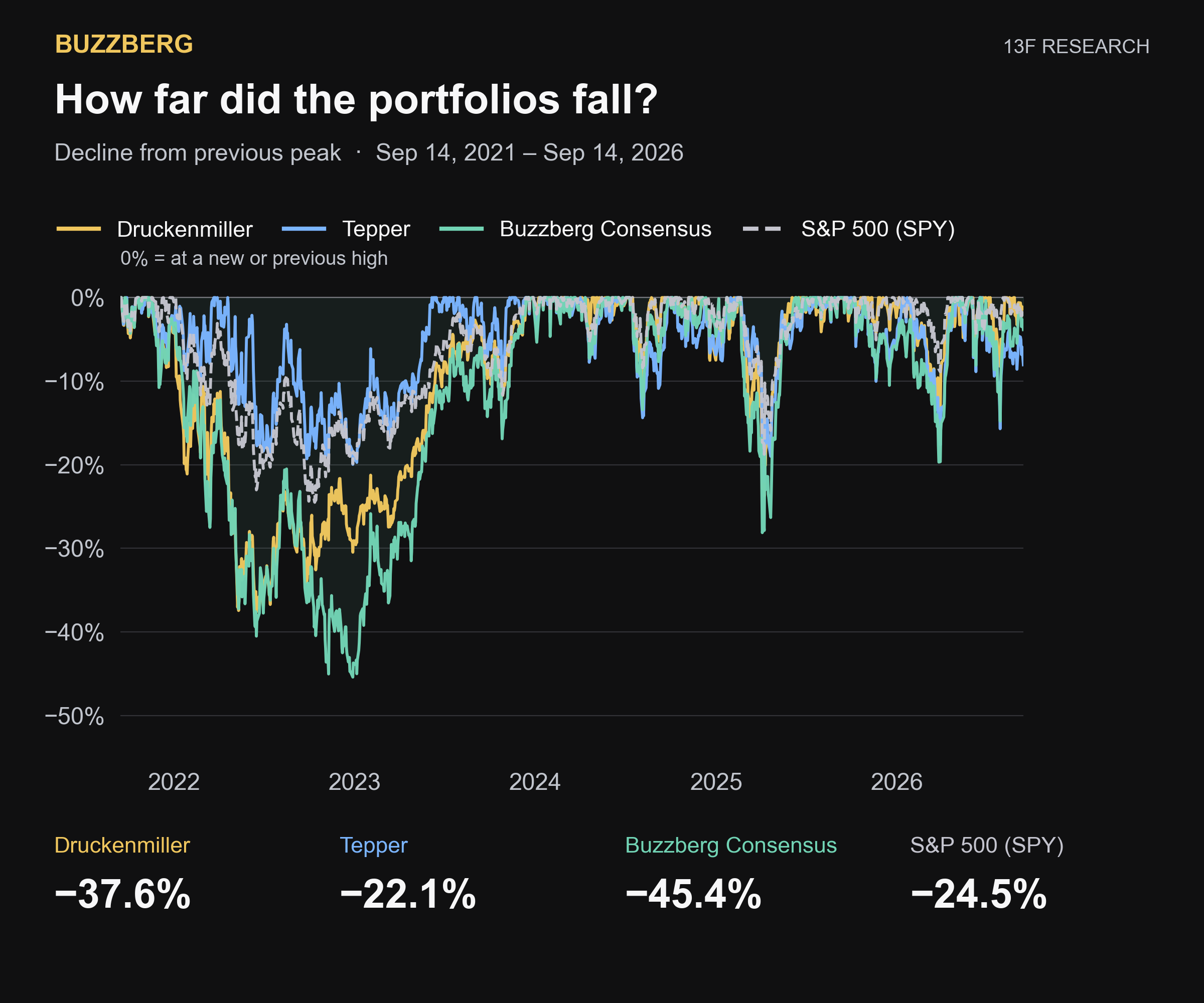
Each line shows how far a portfolio stood below its previous high. The deeper falls in the consensus help explain what an investor would have had to tolerate along the way.
What is in the Consensus Top 10 now?
The latest rebalance in the September 14 data snapshot is August 17, 2026, using disclosures of June 30 holdings from twelve tracked 13F portfolios. This is the latest disclosed consensus, rather than a real-time view of what the managers own today.
| Company | Ticker | Tracked managers holding it |
|---|---|---|
| Amazon | AMZN | 10 |
| Taiwan Semiconductor | TSM | 8 |
| Meta Platforms | META | 8 |
| Alphabet Class A | GOOGL | 7 |
| Micron Technology | MU | 6 |
| SpaceX | SPCX | 6 |
| NVIDIA | NVDA | 6 |
| Microsoft | MSFT | 6 |
| Visa | V | 6 |
| Lam Research | LRCX | 6 |
Each position received a 10% target weight at the rebalance; market moves change those weights afterward. When manager counts tie, the model uses their combined disclosed portfolio weights to order the stocks.
Several businesses on the list supply computing, memory or chipmaking capacity; others operate cloud platforms or serve different markets. It is a useful research list to revisit as filings arrive. To follow subsequent changes, open the current consensus portfolio on Buzzberg.
Leopold Aschenbrenner: what if you copied his AI portfolio?
People were already putting real money behind Leopold Aschenbrenner's disclosed holdings before Situational Awareness ran into trouble. The Next Web, citing Business Insider, reported that roughly $32 million had entered Autopilot's Aschenbrenner strategy between its March 2026 launch and late July. More than 5,000 investors were still copying it in early August. The reporting on his copy-traders.
We tested the same broad idea in Buzzberg: buy the disclosed stocks without leverage and update the portfolio after each new filing. Our copy starts on February 12, 2025, after his first 13F became public. By September 14, 2026, it had gained an estimated 101.2%, versus 27.9% for SPY over the same dates. A hypothetical $10,000 became approximately $20,117, compared with $12,794 in the benchmark. Explore the copy in Buzzberg Callfolio.
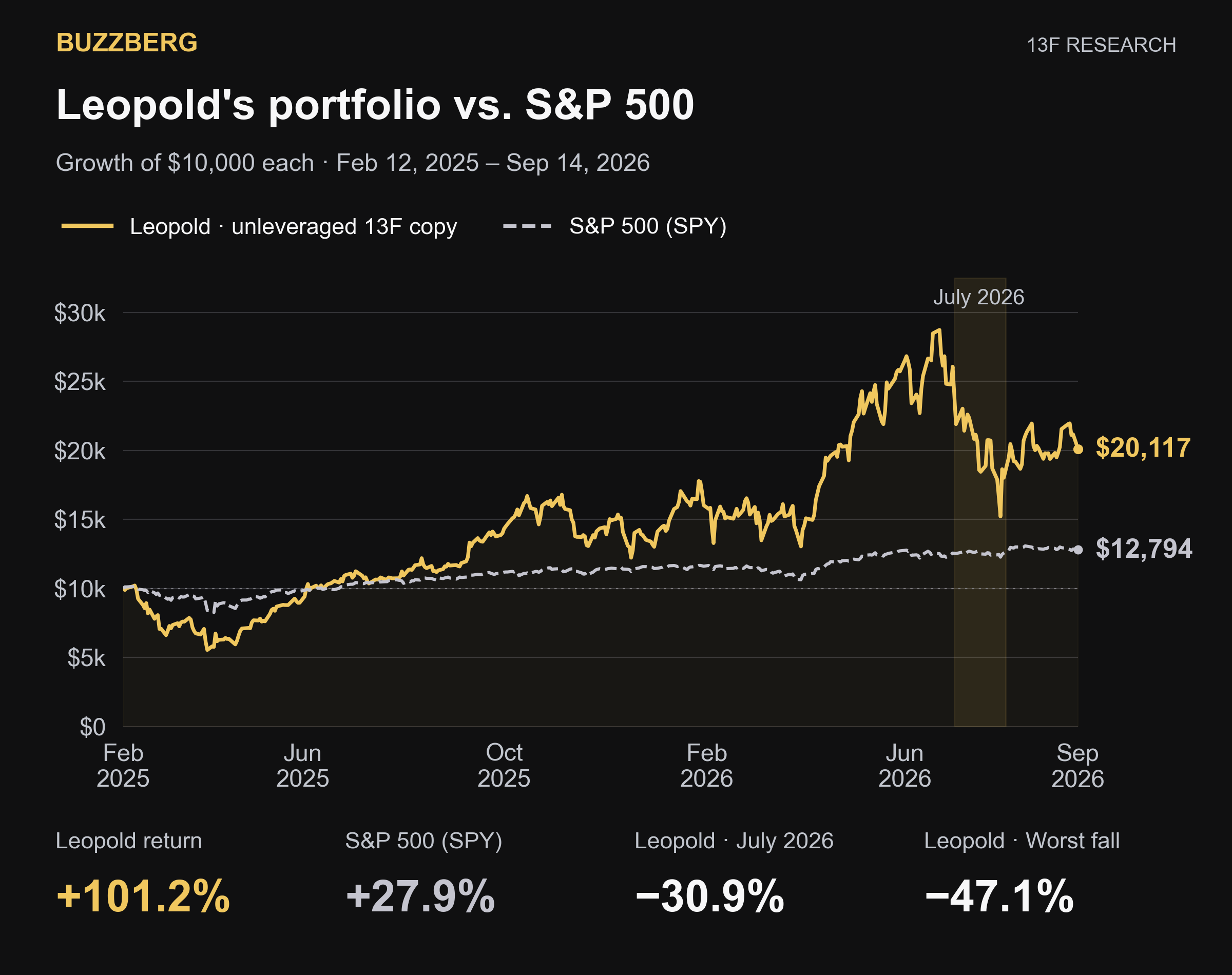
There was a sharp reversal along the way. The copy was up 160.7% by the end of June 2026, then lost 30.9% in July. Its largest decline from a previous peak was 47.1%. It still finished our observation period ahead of SPY, but following it would have required sitting through substantial losses.
The fund's July was worse. Reuters reported a 67% fall in portfolio value, the sale of most of its public-stock portfolio to Citadel and the removal of leverage. Reuters' account.
The good news: without leverage, you wouldn't have been forced to liquidate. With fully paid shares and no margin debt, the price drop would not trigger a margin call. You could choose to keep holding through the drawdown.
The early stock ideas are still worth examining. His March 2025 holdings, published on May 14, included IREN, Applied Digital, CoreWeave and Broadcom. IREN and Applied Digital each represented roughly 4% of the disclosed long-stock portfolio. The original filing.
IREN and Applied Digital build and operate infrastructure for computing; CoreWeave runs a cloud platform for AI. These holdings gave readers specific companies to research behind the broader AI investment story. IREN, Applied Digital, CoreWeave.
A reader buying IREN at the May 14 close paid about $7.97. It reached $43.17 by September 14, 2026: a 442% gain, turning $1,000 into approximately $5,417. Applied Digital went from $5.98 to $24.58, a 311% gain. Both left substantial opportunity after the positions became public; SPY gained 29.5% over those dates.
| Stock | Price after disclosure | Price at cutoff | Price gain |
|---|---|---|---|
| IREN | $7.97 | $43.17 | +441.7% |
| Applied Digital (APLD) | $5.98 | $24.58 | +311.0% |
| CoreWeave (CRWV) | $67.46 | $82.98 | +23.0% |
| Broadcom (AVGO) | $232.12 | $344.72 | +48.5% |
CoreWeave gained 23.0% from the same disclosure, less than SPY. Following an investor early can uncover useful ideas, but the result still depends on the company and the price you pay.
His June 30 holdings were disclosed on August 14, after the portfolio sale had already made the news. That is a practical reason to follow both filings and current reporting. The filing-only copy above kept updating from those quarterly reports; it could not see the intervening trades. Its shorter history also puts it outside our five-year ranking.
How to use these portfolios
Following these investors can give you a useful starting point for your own research. Duquesne could have brought NVIDIA and Vertiv to your attention early. Atreides could have led you toward the companies supplying connectivity and optical components. The consensus could have shown you where several investors were finding opportunities at the same time.
The next step is to ask why the business might be attractive. What is changing in its market? Is demand turning into revenue and cash flow? What would have to happen for today's valuation to make sense? Later filings can show whether the manager adds, trims or exits, while earnings reports and shareholder letters help you understand the investment itself.
If you had used those 2023 holdings as a research list, you might have developed your own case for owning NVIDIA. The filing would have helped you find the idea; your analysis would have determined whether to buy it, how much to own and whether to keep it after the manager sold.
The examples here were selected with the benefit of hindsight, and a filing alone could not have told you which stock would succeed. Their value is in showing that the reporting delay did not remove every opportunity to discover and study an investment.
You can explore the latest holdings, changes and shared positions in Buzzberg Callfolio.