Record SpaceX IPO Climbs in First-Day Trading | Bloomberg Businessweek Daily 6/12/2026
Speakers
Ross Gerber
— CEO, Gerber Kawasaki Wealth Management
Cam Harvey
— Professor of Finance, Duke University Fuqua School of Business
Nick Colas
— Co-Founder, DataTrek Research
Ed Ludlow
— Co-Host, Bloomberg Technology
Max Chafkin
— Bloomberg Businessweek Columnist
Summary
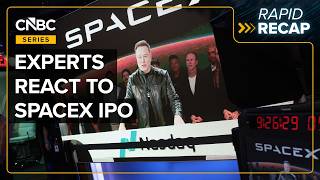
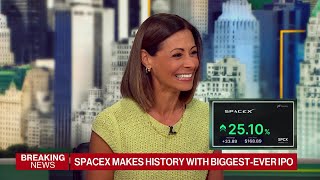
Bloomberg's special edition covers the record SpaceX IPO on its first trading day. Shares surged as much as 30% to a $2.3 trillion market cap, making Elon Musk the first trillionaire. The program examines the AI and Starlink-driven investment thesis, Starship's technical risks, merger speculation with Tesla, and historical IPO performance data that warns of modest long-term returns.
- SpaceX opens at $150 per share and pops up to 30%, raising $75 billion in the largest IPO ever.
- The company is marketed on a $26.5 trillion AI and orbital data center addressable market, though Starlink generates the bulk of revenue.
- Elon Musk holds 84% voting control; insider lock-ups are staggered, with Musk locked for a full year.
- Investor demand was heavily oversubscribed; many institutional and retail buyers received only partial allocations.
- Ross Gerber plans to hold SpaceX for the long term and sees an eventual Tesla-SpaceX merger as a catalyst for Tesla shares.
- Professor Cam Harvey warns that IPOs historically underperform the S&P 500, implying modest expected returns for new investors.
- Technical hurdles remain for Starship reusability, which is critical to both orbital data centers and NASA's moon missions.
- Oil prices fall on progress toward a US-Iran deal to reopen the Strait of Hormuz, supporting broad equity gains.
Ideas
He personally holds SpaceX shares from the Twitter/X investment and will not sell. He believes in the company's long-term mission, the transformative potential of space travel and Starlink, and the strong engineering team. Even without Elon Musk, management is excellent, making SpaceX a generational hold.
Tesla gains from SpaceX merger speculation
He believes a merger or acquisition between SpaceX and Tesla is a foregone conclusion, supported by Gwynne Shotwell's comments on synergies. This expectation props up Tesla's stock as investors hold shares for the potential buyout premium, and Tesla would be worthless without the merger owning the AI IP.
Up Next


This Bloomberg Markets video, published June 12, 2026, features Ross Gerber discussing SPCX, TSLA. 2 trade ideas extracted by AI with direction and confidence scoring.
Speakers: Ross Gerber · Tickers: SPCX, TSLA