Ideas
KOSPI to reach 5,000 via large-cap inflows.
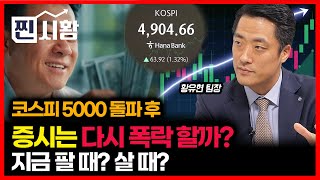
KOSPI broke above 4,900 with leadership from large caps such as Samsung Electronics, SK hynix, and Hyundai Motor. Retail deposits and CMA balances are ample, foreign inflows are returning even with FX concerns, and he expects KOSPI to reach 5,000 this week as earnings and valuations support further upside.
Memory supercycle drives Korean memory duo.
Memory earnings are in a supercycle: Samsung Electronics could earn 140-150 trillion won this year with another 20% growth in 2027, and SK hynix around 120 trillion won. Applying higher PER multiples implies Samsung around 300,000 won and SK hynix around 1.5 million won. He maintains a heavy weighting and would buy them over Hyundai on the day.
Insider buying signals Micron upside.
Micron's former TSMC chairman Mark Liu bought about $7.8 million of Micron stock after a threefold rally, which is a rare high-conviction insider buy at an elevated price. This is a positive signal for Micron and memory.
Korean biotech is bottoming; accumulate gradually.
Korean biotech and pharma have been underowned and appear to be bottoming. As money rotates from robots and batteries, biotech can attract flows, so he advises gradually accumulating, including via ETFs and post-? names.
Robot re-rating lifts Hyundai Motor valuation.
Hyundai Motor is being re-rated as a robot and autonomous-driving company rather than just an automaker. Atlas mass production is more realistic than Tesla's Optimus timeline, and Hyundai has its own factories. Foreign ownership has fallen to 35% from 41%, leaving room for foreign buying, while autonomous driving can improve margins; short-term period adjustment is possible but the upward trend is intact.
LG Electronics gains robot valuation upside.
LG Electronics can receive robot valuation because it has businesses tied to robotics and actuators, and its profitability is better than many large-cap peers. It has underperformed other Korean large caps, leaving upside if robot momentum continues.
Auto-robot electronics demand lifts component suppliers.
Auto and robot electronics content is rising. Camera modules and components are used in both EVs and robots, and large-cap suppliers such as Samsung Electro-Mechanics and LG Innotek have profitability and can be checked for upside.
Financials must lead KOSPI to 5,000.
For KOSPI to reach 5,000, financials must participate. KB Financial and securities holding companies can rise on the third commercial law revision and value-up momentum. Although the move may feel slow, the risk/reward is favorable.
Gas turbines and fuel cells benefit.
Trump's emergency power auction and PJM rule changes push Big Tech data centers to fund their own generation instead of relying on the grid. The fastest solutions are onsite gas turbines and fuel cells, so GE Vernova and Bloom Energy are direct beneficiaries.
KOSDAQ rotation may follow large-cap run.
KOSPI large-cap earnings season is likely to dominate until late January, but after that the market may rotate to KOSDAQ as large-cap results conclude. Style change is a key variable to watch.
Atlas production lifts Korean robot auto parts.
Hyundai's Atlas robot mass-production plans are drawing attention to Korean auto parts makers with robot exposure. Hyundai Mobis is expected to supply Atlas actuators and battery modules, HL Mando has robot actuator and sensor growth, and SL may supply head and body modules, offering earnings leverage.
Artemis catalyst lifts Korean aerospace shares.
NASA's Artemis 2 lunar flyby may launch in early February, a near-term catalyst for the space industry. Korean aerospace and space stocks such as Korea Aerospace Industries can benefit from momentum.
Korean nuclear and power equipment benefit.
US power demand and nuclear two-track strategy for SMRs and large reactors are accelerating. Korea's SMR construction speed and nuclear equipment capabilities position Korean suppliers to win overseas projects. Beneficiaries include Doosan Enerbility, Hyundai E&C, and Hyosung Heavy Industries.
LNG and tanker cycle lifts Korean shipbuilders.
LNG carrier orders are expected around 100 vessels this year versus Korean capacity of about 75, and sanctions on the shadow tanker fleet are spurring replacement demand. Weak won assumptions and rising ship prices support earnings and further upside for Korean shipbuilders such as Hanwha Ocean, Samsung Heavy Industries, and HD Hyundai Heavy Industries.
Geopolitical risk lifts Korean defense exporters.
Trump's Greenland claims and tariff threats against European countries are raising geopolitical risk and NATO tensions. This supports Korean defense exporters as European rearmament and global defense demand increase.
Rare earth restrictions lift MP and POSCO.
China's tighter rare earth export reviews toward Japan and Greenland resource competition underscore supply chain risk. MP Materials is the main US rare earth producer with Defense Department backing, while POSCO International is watched as a Korean beneficiary.
Capex cycle lifts Korean semiconductor equipment.
Samsung Electronics and SK hynix are expected to report strong results and continue capex, which should lead to orders for Korean semiconductor equipment and materials suppliers and revenue recognition in the first half. VM's SK hynix order disclosure is an example.
Battery rally lacks fundamental support; avoid.
The latest Korean battery rally was driven by a humanoid-robot battery narrative rather than fundamental improvement, so the move may lack continuity. He advises caution until fundamentals confirm.
Won weakness persists on structural outflows.
The won's weakness is not mainly foreign selling but structural domestic outflows. Pensions, retail investors, and indirect assets are steadily increasing overseas allocations. Foreigners are still net buyers of Korean assets, but their purchases are smaller than domestic outflows, so USD/KRW should remain in the mid-to-high 1,400s and the government is unlikely to force a sharp won recovery.
Long-term Korean bond yields rise.
As domestic deposits move into risk assets and overseas investments, domestic liquidity tightens and long-term Korean bond yields rise. Credit spreads may stay low, but bond investors face losses as rates climb.
Food stockpiling supports grains and fertilizer.
European and Asian countries are returning to strategic food stockpiling due to hybrid warfare risks, climate shocks, and unreliable supply chains. If many countries stockpile at once, global food supply chains tighten, supporting grain and fertilizer prices; fertilizer and seeds are also strategic imports.
This 3PRO TV (삼프로TV) video, published January 19, 2026,
features Lee Jae-kyu, Kim Jang-yeol, Lee Jo, Park Geun-hyung, Seo Young-soo, Eo Ye-jin
discussing EWY, 005930.KS, 000660.KS, MU, Korean Biotech/Pharma Sector, 005380.KS, 066570.KS, 009150.KS, 011070.KS, 105560.KS, Korean securities/brokerage sector, GEV, BE, KOSDAQ, 012330.KS, 204320.KS, 005850.KS, 047810.KS, Korean aerospace/space sector, 034020.KS, 000720.KS, 298040.KS, 042660.KS, 010140.KS, 329180.KS, Korean defense sector, MP, 047050.KS, Korean semiconductor equipment/materials sector, VM, KARS, USD/KRW, Korean long-term government bonds, DBA, Fertilizer.
21 trade ideas extracted by AI with direction and confidence scoring.
Speakers:
Lee Jae-kyu,
Kim Jang-yeol,
Lee Jo,
Park Geun-hyung,
Seo Young-soo,
Eo Ye-jin
· Tickers:
EWY,
005930.KS,
000660.KS,
MU,
Korean Biotech/Pharma Sector,
005380.KS,
066570.KS,
009150.KS,
011070.KS,
105560.KS,
Korean securities/brokerage sector,
GEV,
BE,
KOSDAQ,
012330.KS,
204320.KS,
005850.KS,
047810.KS,
Korean aerospace/space sector,
034020.KS,
000720.KS,
298040.KS,
042660.KS,
010140.KS,
329180.KS,
Korean defense sector,
MP,
047050.KS,
Korean semiconductor equipment/materials sector,
VM,
KARS,
USD/KRW,
Korean long-term government bonds,
DBA,
Fertilizer