Ideas
Hold KOSPI while forward EPS rises.
KOSPI is in an earnings-driven bull market. Since 2001, KOSPI has shown a 0.93 correlation with 12-month forward EPS, and there has been no sustained downtrend while forward EPS rises. His H1 2026 target is around 5,300; if EPS rises another 5%, 11.2x P/E implies 5,468 and 12x implies 5,600, so he prefers keeping upside open and holding the index until forward EPS stops rising. The main risk is 2026-2027 earnings rolling over, especially if 2027 semiconductor operating profit growth turns negative.
Korean chip earnings still strong.
Korean semiconductor earnings power is the core KOSPI driver: 2026 semiconductor operating profit consensus rose from about KRW 80tn in September 2025 to over KRW 200tn, with one-month consensus above KRW 230tn. Semiconductor tariffs are viewed as a negotiation card rather than an immediate shock, and Korean/Taiwan chip stocks did not sell off materially; semiconductors are also not among the top US export categories most exposed to a tariff Plan B. However, if 2027 semiconductor operating profit growth slows to 4.8% or turns negative, he would turn cautious.
Buy Treasuries as tariff uncertainty fades.
Once the US Supreme Court tariff ruling is resolved, trade-policy uncertainty should ease and Treasury yields should stabilize or trend lower. Even if the ruling invalidates IEEPA tariffs, the alternative legal tools have lower tariff caps and stricter conditions, and tariff recovery would take time; this should be less concerning for markets than many fear. He therefore recommends viewing the post-ruling phase as one of uncertainty reduction and lower bond yields.
Watch Korean export sectors on tariff risk.
If the Supreme Court strikes down IEEPA tariffs and Trump moves to a weaker Plan B, Korean sectors with high US export exposure could wobble. The top US-bound export categories include vehicles, nuclear reactor machinery, electrical machinery/equipment, and petroleum products; autos, nuclear power, and power equipment already weakened during the Greenland tariff scare. Semiconductors are relatively insulated, so the risk is concentrated in these other export sectors.
Prefer S&P 500 and Dow over Nasdaq.
If Trump pivots toward a fiscal stimulus drive before the midterms, S&P 500 and Dow are more attractive than Nasdaq because the stimulus would be domestic-demand oriented. Nasdaq can still rise, but AI profitability concerns have reduced its upside momentum, so he prefers broad US large-cap indices over AI-heavy Nasdaq.
Prefer S&P 500 and Dow over Nasdaq.
If Trump pivots toward a fiscal stimulus drive before the midterms, S&P 500 and Dow are more attractive than Nasdaq because the stimulus would be domestic-demand oriented. Nasdaq can still rise, but AI profitability concerns have reduced its upside momentum, so he prefers broad US large-cap indices over AI-heavy Nasdaq.
Favor Alphabet; avoid Oracle and Broadcom.
The AI profitability controversy triggered differentiation rather than a sector-wide bubble. Investors should now separate AI names by profitability, stability, and cash flow: Alphabet has performed well, while Oracle and Broadcom have failed to rebound properly after sharp declines. Nasdaq P/E has fallen since its 2020 peak, supporting the view that this is not a broad AI bubble but a stock-picking market.
Favor Alphabet; avoid Oracle and Broadcom.
The AI profitability controversy triggered differentiation rather than a sector-wide bubble. Investors should now separate AI names by profitability, stability, and cash flow: Alphabet has performed well, while Oracle and Broadcom have failed to rebound properly after sharp declines. Nasdaq P/E has fallen since its 2020 peak, supporting the view that this is not a broad AI bubble but a stock-picking market.
Fiscal stimulus favors US consumer stocks.
If Trump launches the expected fiscal/demand stimulus drive—consumer coupons, tax cuts, and pressure on the Fed for rate cuts—US consumer-related stocks could be especially strong. Because the stimulus is domestic-demand oriented, it favors consumer exposure more than AI-led Nasdaq growth.
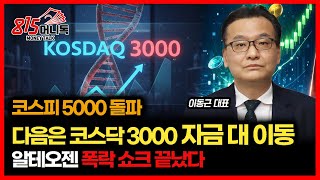
This 815 Money Talk (815머니톡) video, published January 23, 2026,
features Lee Gyeong-min
discussing EWY, Korean semiconductor sector, TLT, Korean autos, Korean nuclear reactor machinery, Korean electrical and power equipment, Korean petroleum products, SPY, DJI, NASDAQ Composite, GOOGL, ORCL, AVGO, XLY.
9 trade ideas extracted by AI with direction and confidence scoring.
Speakers:
Lee Gyeong-min
· Tickers:
EWY,
Korean semiconductor sector,
TLT,
Korean autos,
Korean nuclear reactor machinery,
Korean electrical and power equipment,
Korean petroleum products,
SPY,
DJI,
NASDAQ Composite,
GOOGL,
ORCL,
AVGO,
XLY