Ideas
US must scale electricity production fast
Friedberg argues the binding constraint on US growth is electricity supply. The current US plan only moves from roughly 1 to 2 terawatts by 2040 while China moves from 3 to 8 and is adding the equivalent of an entire United States of generating capacity every 18 months. He says electricity production is what lowers the price of everything else, raises GDP, creates jobs and decides whether the US can actually power AI, so capacity has to be expanded from every available source.
Subsidy cuts hurt solar, favor nuclear
Friedberg is not a fan of energy that depends on government subsidies, so he reads the removal of the IRA solar, wind and EV credits as near-term demand destruction for solar and wind but a net positive overall. The underlying electricity demand does not disappear, so he expects a natural market force to pull capital toward nuclear, helped by Secretary Wright's position and Trump's executive orders cutting the nuclear regulatory burden. He concedes the jury is absolutely out because the nuclear proliferation has not begun.
Subsidy cuts hurt solar, favor nuclear
Friedberg is not a fan of energy that depends on government subsidies, so he reads the removal of the IRA solar, wind and EV credits as near-term demand destruction for solar and wind but a net positive overall. The underlying electricity demand does not disappear, so he expects a natural market force to pull capital toward nuclear, helped by Secretary Wright's position and Trump's executive orders cutting the nuclear regulatory burden. He concedes the jury is absolutely out because the nuclear proliferation has not begun.
Gas turbines sold out until 2030
From underwriting his own 1 gigawatt data center, Chamath says an order placed today cannot get a gas turbine viable and turned on before 2030. He stresses this is not a technology issue but purely a supply chain issue, which makes turbine capacity, not generation technology, the scarce asset in the power build-out.
Grid and storage are the bottleneck
Chamath argues the energy debate is no longer about production but about supply, transmission, distribution and storage. He notes California is in an energy deficit only about five days a year and the PG&E grid runs at roughly 45-50 percent average utilization, so the artificial constraints sit downstream of generation. If that downstream capacity and storage are not built out, robotics and AI demand will arrive with no way to deliver the power.
Nuclear arrives too late to matter
Chamath thinks federal deregulation will not be what decides nuclear. The real blockers are local and state regulators and their willingness to approve and switch these plants on. Because these are ten-year projects, even a green light today means the earliest units run around 2032-2033, which he calls far too late for the electricity demand arriving now, with the added risk of being blocked at the last minute after capital is committed.
Any US electricity production wins long-term
Chamath says he is a fan of all forms of energy production and that the marginal cost of energy has to go to zero, which in his view makes any single way of getting your hands on US electricity production a winning trade over the next twenty years. He backs this with his own move into a 25 billion dollar, 1 gigawatt data center outside Phoenix sited downstream of a nuclear reactor, and says the whole policy goal should be to let energy be made wherever and whenever possible.
Solar's 17-month payback beats everything else
Even with subsidies stripped out, Chamath says solar's single most valuable underwriting feature is speed: roughly 17 months from the first dollar in to generating revenue, versus a decade or more for other generation assets. A short payback period means far less exposure to world volatility and to the high rate of return needed to justify a 10-15 year investment cycle, so he would remove the subsidies but keep building solar because it is the fastest way to add electricity.
Falling dollar imports inflation into everything
Friedberg frames the 11 percent fall in the dollar as the moment the spending and spiraling debt finally show up in prices. The US imports 4 to 5 trillion dollars of goods and services a year, so the cost of all of it just rose about 11 percent before any tariff effect. If that compounds while wages and asset values do not keep pace, it produces dollar devaluation, asset devaluation and income devaluation, which he believes is exactly what drives the political demand for socialism and more free government spending.
Dollar decay continues; stay somewhat short
Chamath points out the dollar has already devalued roughly 50 percent over the last 35 to 40 years, so the current move is not new: it is the continuation of a one-way trade caused by the United States financing a lot of its growth with debt. He says that until the US runs surpluses or eliminates the debt there will always be a reason to be somewhat short the dollar, but he expects a slow, manageable bleed and a carry you simply pay, not a cataclysmic collapse.
Own US assets despite dollar decay
Chamath's answer to dollar decay is to own the dollar-denominated assets rather than the currency: if asset prices rise faster than the dollar falls you are still ahead, and US equities, real estate and hard assets remain the global flight-to-quality bid. He argues the only real boundary condition is not the dollar or the debt but a collapse in the quality of US human capital and its ability to innovate, which would take 50 to 100 years to play out, so betting against the United States stays the losing side of the trade for most of our lifetimes.
Tariffs push foreign buyers into Treasuries
Using the Vietnam trade deal as the worked example, Chamath says a country facing roughly 26 billion dollars of tariffs first sells dollar-denominated assets, including bonds, to raise the dollars it must send to the US Treasury, which looks bad for asset prices. But he argues the second-order effect dominates: in a turbulent world those governments and their citizens want safe assets, so the central bank ends up long US bonds and fixed income and local holders add US exposure on a weighted basis, which keeps expanding America's balance sheet.
Other markets are having their day
Pushing back on the American exceptionalism case, Friedberg notes businesses are now booming in India, in China and in other countries in the way they used to boom strictly in the US, and that foreign holdings of US Treasuries have fallen from 34 percent over the last ten years. His point is that other markets appear to be having their day, so US assets no longer automatically capture global growth and a US-only allocation costs you an 11 percent currency drop in six months.
AI may absorb vertical SaaS demand
Chamath says he actually believes the OpenAI and Anthropic revenue ramps, which is why the state of software looks unclear to him: foundational models may absorb a growing share of what application software is paid for. His sharper point is organizational. Vertical software was durable because companies had vertically specialized departments, and if AI turns that specialized work into agents and horizontal generalists, there is nobody left inside the company asking the CFO for the HR tool or the project management tool. He expects investors to front-run this and price the end state 24 to 36 months forward.
Short Adobe against the Figma IPO
Rather than bet up or down on AI, Chamath describes a free money trade: put 50 to 100 million dollars long the Figma IPO against an equivalent short in Adobe and book the spread. His reasoning is that even if the AI disruption of design software arrives unseen, the incumbent takes the valuation retrade first and faster than the higher-growth newcomer, so the Adobe short hedges the position and should still make money.
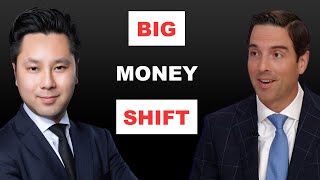
This All-In Podcast video, published July 04, 2025,
features David Friedberg, Chamath Palihapitiya
discussing Power infrastructure, SOLAR, URA, Gas turbine manufacturers, Electricity transmission and distribution, ICLN, UUP, VTI, US Real Estate, TLT, INDA, FXI, IGV, ADBE.
15 trade ideas extracted by AI with direction and confidence scoring.
Speakers:
David Friedberg,
Chamath Palihapitiya
· Tickers:
Power infrastructure,
SOLAR,
URA,
Gas turbine manufacturers,
Electricity transmission and distribution,
ICLN,
UUP,
VTI,
US Real Estate,
TLT,
INDA,
FXI,
IGV,
ADBE