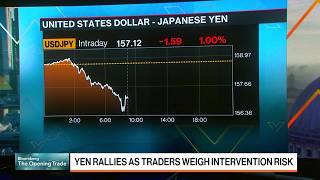
Big Yen Spike Leaves Traders Guessing On Intervention

Watch on YouTube ↗  |  September 03, 2026 at 12:36  |  5:37  |  Bloomberg Markets
Speakers
Skyler Montgomery Koning — Macro Strategist

Summary

The video covers the yen's sharp rebound and speculation about Japanese or coordinated US-Japan intervention after dollar-yen fell from around 160 toward the 156-158 area. Bloomberg macro strategist Skylar Montgomery Koning explains why multilateral intervention would be more credible and could drive significant yen appreciation, while the Bank of Japan's potential for faster tightening adds another yen-supportive risk. She also discusses the GPIF's unusual review and the risk that Japanese pension repatriation could support Japanese assets while pressuring U.S. Treasuries and French government bonds.

  • Yen rebounds sharply, with dollar-yen falling from 160 toward 156-158.
  • Markets focus on the 160 level as a potential intervention trigger.
  • Coordinated US-Japan intervention seen as more credible than unilateral action.
  • Attention on the next Bank of Japan meeting and possible oversized 50bp hike.
  • Roughly 100bp of BOJ tightening is priced over 12 months.
  • GPIF's unusual review raises prospect of more Japanese domestic investment.
  • Foreign bond markets, especially France, could face repatriation pressure.
Ideas
Skyler Montgomery Koning Macro Strategist 0:07
Coordinated intervention risk could sharply lift yen
Intervention risk is centered on the 160 level in dollar-yen; the market is nervous and may defend key levels for the Bank of Japan. Unilateral intervention typically fails to create sustained appreciation, but if the US is involved in a more concerted multilateral intervention than last time, it would be more credible because the US has ample dollars, and could trigger a significant yen appreciation.
Skyler Montgomery Koning Macro Strategist 3:41
GPIF domestic shift could support Japanese assets
The Government Pension Investment Fund's unusual review, prompted by the prime minister's calls to invest more domestically, could shift large Japanese pension assets toward local markets. Japanese equities have become significantly more attractive and Japanese bonds now offer income, and a government-driven allocation shift has historically been large enough to support Japanese assets and the yen.
Skyler Montgomery Koning Macro Strategist 4:24
GPIF repatriation could pressure U.S., French bonds
If GPIF and other Japanese pension funds repatriate foreign holdings, they could sell U.S. Treasuries and French government bonds, putting pressure on those markets. France has about 60% foreign ownership of government bonds and more price-sensitive holders, while the US has roughly 25%; Japanese investors have been sticky but could follow a GPIF change.
Up Next

This Bloomberg Markets video, published September 03, 2026, features Skyler Montgomery Koning discussing FXY, EWJ, JGBUX, TLT, OAT. 3 trade ideas extracted by AI with direction and confidence scoring.

Speakers: Skyler Montgomery Koning  · Tickers: FXY, EWJ, JGBUX, TLT, OAT